Key Takeaways & Executive Findings
- •• Controlling crystal size of ZnAtzPO4 significantly enhances kinetic separation of ethylene/ethane, boosting selectivity from 1.3 to 98.5. • Synthesis parameters (temperature, concentration, molar ratio) allow precise tuning of crystal size, offering a scalable strategy for adsorbent optimization. • The study provides a new design principle for microporous materials: morphology control to amplify diffusion differences for challenging gas separations. • This approach offers an energy-efficient alternative to cryogenic distillation for olefin/paraffin separation, contributing to carbon neutralization goals.
Abstract
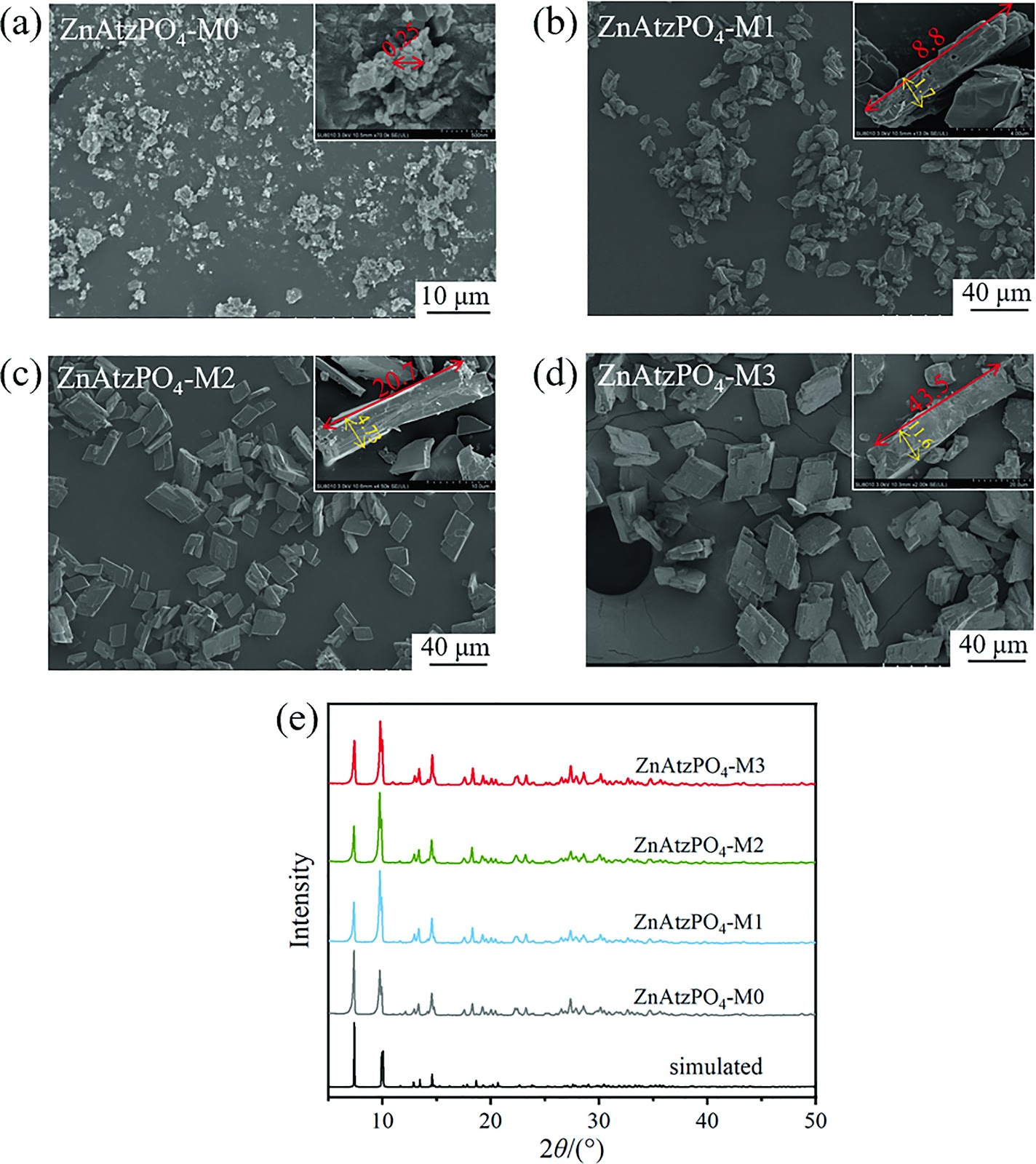
The adsorptive separation of C2H4 and C2H6, as an alternative to distillation units consuming high energy, is a promising yet challenging research. The great similarity in the molecular size of C2H4 and C2H6 brings challenges to the regulation of adsorbents to realize efficient dynamic separation. Herein, we reported the enhancement of the kinetic separation of C2H4/C2H6 by controlling the crystal size of ZnAtzPO4 (Atz = 3-amino-1,2,4-triazole) to amplify the diffusion difference of C2H4 and C2H6. Through adjusting the synthesis temperature, reactant concentration, and ligands/metal ions molar ratio, ZnAtzPO4 crystals with different sizes were obtained. Both single-component kinetic adsorption tests and binary-component dynamic breakthrough experiments confirmed the enhancement of the dynamic separation of C2H4/C2H6 with the increase in the crystal size of ZnAtzPO4. The separation selectivity of C2H4/C2H6 increased from 1.3 to 98.5 with the increase in the crystal size of ZnAtzPO4. This work demonstrated the role of morphology and size control of adsorbent crystals in the improvement of the C2H4/C2H6 kinetic separation performance.
1. Introduction
Ethylene (C2H4) is a key feedstock to many chemicals and polymers [1]. During the production of ethylene from the steam-cracking reaction of carbon-based feedstocks, ethane (C2H6) is one of the main impurities. C2H6 must be removed from C2H4 to produce high-pure C2H4 for the polymer production process. The present industrial method to enrich C2H4 from C2H4/C2H6 mixtures mostly relied on cryogenic distillation, requiring a large energy consumption, ca. 0.3% of global energy [2]. Under the global urgent obligation of carbon neutralization, all kinds of energy-saving transformations of chemical plants will be a long-term significant reform, including the introduction of adsorption separation technology [3–8]. And for the adsorptive separation of C2H4/C2H6 mixtures, the exploration of efficient adsorbents is of great significance.
However, the intrinsically small and similar molecular sizes [9,10] of C2H4 (0.328 nm × 0.418 nm × 0.484 nm) and C2H6 (0.381 nm × 0.408 nm × 0.482 nm) make it challenging to explore efficient adsorbents with high C2H4/C2H6 selectivity. Many researchers have explored various types of materials to selectively adsorb C2H4 from C2H4/C2H6 mixture [10–36]. So far, the design strategy of adsorbents with efficient separation performance can be mainly classified into two categories. For the first class of adsorbent design, transition-metal ions and unsaturated metal sites were introduced into porous materials, such as Fe-MOF-74 [12] and PAF-1-SO3Ag [22], performing efficient separation by thermodynamic effect. The IAST (ideal adsorbed solution theory) separation selectivity of C2H4/C2H6 on Fe-MOF-74 and PAF-1-SO3Ag were as high as 13–18 and 27, respectively. However, the preferentially interact of PAF-1-SO3Ag with the p-electrons of C2H4 molecules resulted in relatively high adsorption energy (106 kJ·mol−1) [17]. The second class of design strategy was controlling the pore size and pore structure of adsorbents to realize kinetic separation based on the diffusion rate. In an ideal scenario, approximately selective molecular sieving of C2H4 and C2H6 based on large diffusion rates was illustrated by UTSA-280 (pore size 0.3–0.4 nm) [19] and Mg-gallate (pore size 0.356 nm) [26]. Other adsorbents such as ITQ-55 [16], Cu(OPTz) [22] showed potential separation performance by kinetic effect. The selectivity for kinetic separation of C2H4/C2H6 was up to 50 on ITQ-55 with heart-shaped cages and framework flexibility. Recently, our group [17] reported an ultra-microporous metal–organic framework [Zn3(Atz)3(PO4)]·(ZnAtzPO4, Atz = 3-amino-1,2,4-triazole) for efficient separation of C2H4 and C2H6 by exploiting equilibrium-kinetic synergetic effect. The ZnAtzPO4 adsorbent showed high C2H4/C2H6 selectivity and low adsorption energy.
Loading authentic research manuscript (Pages 1–5)...
Yixuan Ma, Cong Yu, Lifeng Yang, Rimin You, Yawen Bo, Qihan Gong, Huabin Xing, Xili Cui (2023). Boosting kinetic separation of ethylene and ethane on microporous materials via crystal size control. Chinese Journal of Chemical Engineering. https://doi.org/10.1016/j_cjche_144874886
Research & Educational Purpose Only:The translations, structured abstracts, analytical annotations, and data reports provided by SinoTechIntel are intended exclusively for academic research, internal corporate R&D, and educational benchmarking. They do not constitute formal engineering, chemical safety, legal, or professional advice.
Copyright & Intellectual Property Notice: Original copyright of the underlying source articles and experimental data remains with the respective authors, institutions, and original publishing journals. SinoTechIntel claims intellectual property only over its proprietary translations, analytical syntheses, and AEO structured enhancements in accordance with international fair use and academic citation principles.
Frequently Asked Questions
What is the main objective of this study?
The main objective is to enhance the kinetic separation of ethylene (C2H4) and ethane (C2H6) by controlling the crystal size of the microporous material ZnAtzPO4, thereby amplifying the diffusion difference between the two gases.
How was the crystal size of ZnAtzPO4 controlled?
The crystal size was controlled by adjusting synthesis parameters including temperature, reactant concentration, and the molar ratio of ligands to metal ions.
What were the key results regarding separation selectivity?
The separation selectivity of C2H4/C2H6 increased dramatically from 1.3 to 98.5 as the crystal size of ZnAtzPO4 increased, demonstrating a significant enhancement in kinetic separation performance.
Why is this research significant for industrial applications?
This research offers an energy-efficient alternative to cryogenic distillation for olefin/paraffin separation, which is a major energy consumer in the chemical industry. By controlling crystal size, the performance of adsorbents can be optimized, contributing to carbon neutralization goals.
What methods were used to evaluate the separation performance?
The separation performance was evaluated using single-component kinetic adsorption tests and binary-component dynamic breakthrough experiments.
Related Technical Papers & Translations

Design and optimization of a high-efficiency distillation process for cellulosic fuel ethanol integrated with thermal coupling and molecular sieve adsorption
To address the challenges of high energy consumption and prominent costs in the traditional three-columns distillation process for cellulosic fuel ethanol, a distillation—molecular sieve coupling separation process is proposed. This process integrates a three-column (crude distillation column, first distillation column, second distillation column) system with a 3A molecular sieve adsorption deep dehydration unit. A thermal coupling network is constructed via differential pressure design (steam from medium/high-pressure columns as mutual heat sources, reboiler liquid waste heat for feed preheating), and molecular sieve adsorption conditions are optimized. The study first performs a thermodynamic consistency test on the ethanol—water system, determines optimal non-random two-liquid (NRTL) model binary interaction parameters via experimental data regression for Aspen Plus simulation. Aiming at minimum total annual cost (TAC), Aspen Plus is used to optimize process parameters (theoretical tray number, feed location, reflux ratio, side-draw position, etc.). Economic analysis shows this process reduces CO2 emission costs by 27.56%, TAC by 15.58% (to 5.123 × 10⁶ USD·a-1), and increases ethanol purity to >99.6%, providing an effective solution for green, efficient separation.

A cohesion loss model for determining residual strength of deep bedded sandstone
Rock residual strength, as an important input parameter, plays an indispensable role in proposing the reasonable and scientific scheme about stope design, underground tunnel excavation and stability evaluation of deep chambers. Therefore, previous residual strength models of rocks established were reviewed. And corresponding related problems were stated. Subsequently, starting from the effects of bedding and whole life-cycle evolution process, series of triaxial mechanical tests of deep bedded s

Federated model with contrastive learning and adaptive control variates for human activity recognition
Recent attention to privacy issues demands a communication-safe method for training human activity recognition (HAR) models on client activity data. Federated learning (FL) has become a compelling technique to facilitate model training between the server and clients while preserving data privacy. However, classical FL methods often assume independent and identically distributed (IID) data among clients. This assumption does not hold true in practical scenarios. Human activity in real-world scena