Key Takeaways & Executive Findings
- •• Ti2BS2 and Ti2BSe2 exhibit strong adsorption toward soluble lithium polysulfides, effectively suppressing the shuttle effect in Li-S batteries. • These functionalized 2D transition metal borides significantly accelerate the redox kinetics of lithium polysulfides, enhancing battery performance. • Low decomposition energy barrier for Li2S and low Li-ion diffusion barrier indicate excellent catalytic activity for Li2S oxidation. • Metallic conductivity maintained throughout charge/discharge cycles, ensuring efficient electron transport and high-rate capability.
Abstract
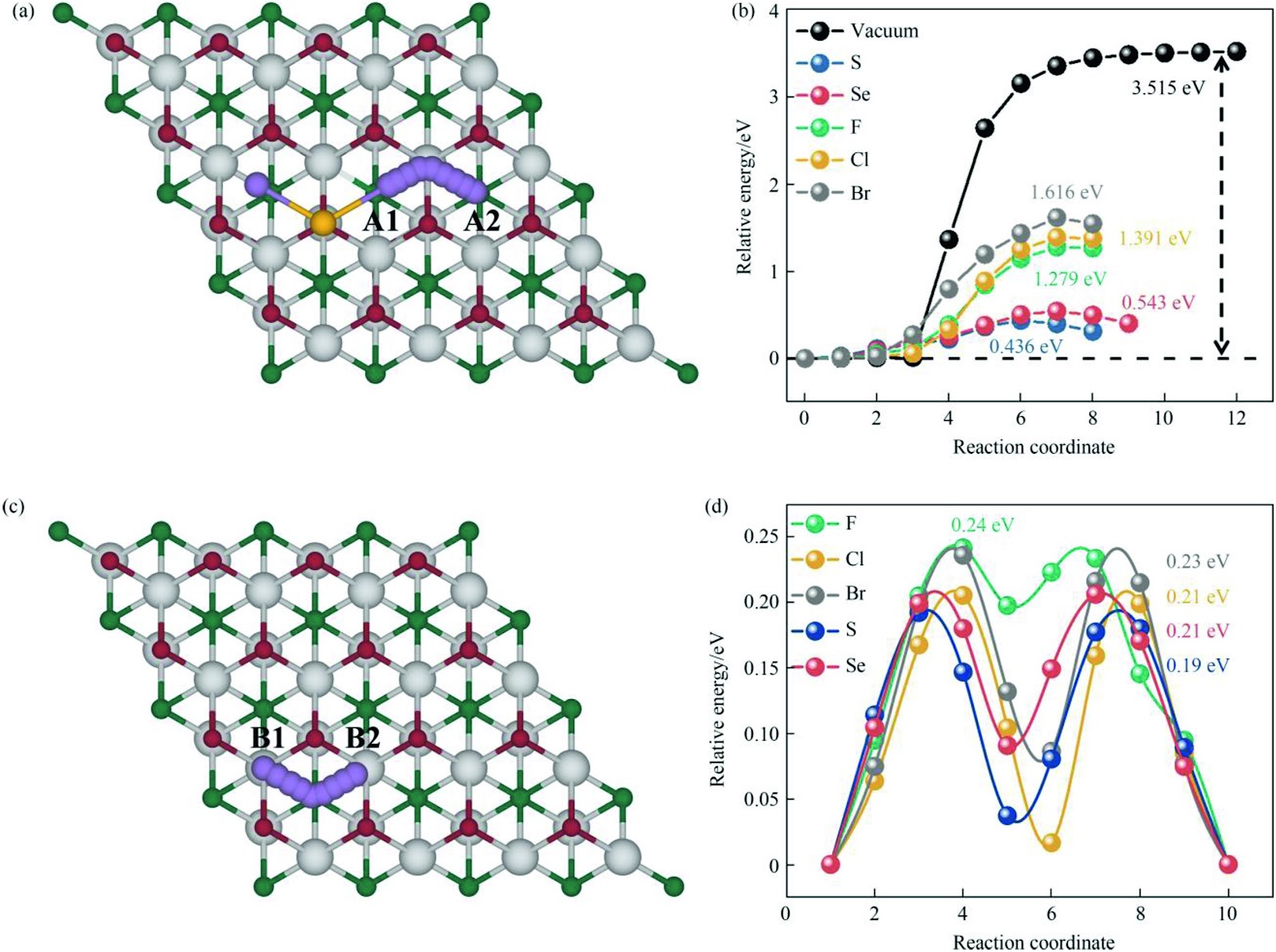
Lithiumesulfur (LieS) batteries are regarded as one of the most promising next-generation energy storage systems due to their high theoretical specific energy density and low cost. However, serious shuttle effect and sluggish lithium polysulfides (LiPSs) redox kinetics severely impede the practical application of LieS batteries. Employing polar sulfur hosts is an effective strategy to alleviate the above problems. Herein, the potential of two-dimensional (2D) Ti2B-based sulfur hosts for LieS batteries was comprehensively explored using first-principles calculations. The results show that functional groups of Ti2B can significantly modulate its structural properties, thus affecting its interaction with sulfur-containing species. Among S, Se, F, Cl, and Br elements, Ti2B terminated with S and Se atoms possess stronger adsorption capability towards soluble Li2S8, Li2S6, and Li2S4, obviously stronger than organic electrolytes, which indicates that they can completely suppress the shuttle effect. Besides, Ti2BS2 and Ti2BSe2 can powerfully expedite the electrochemical conversion of LiPSs. Moreover, the decomposition energy barrier of Li2S and diffusion energy barrier of single Li ion on them are also fairly low, manifesting their excellent catalytic performance towards the oxidation of Li2S. Finally, Ti2BS2 and Ti2BSe2 always keep metallic conductivity during the whole charge/discharge process. Taking all this into account, Ti2BS2 and Ti2BSe2 are proposed as promising bifunctional sulfur hosts for LieS batteries. Our results suggest that increasing the proportion of S and Se groups during the synthesis of Ti2B monolayers is greatly helpful for obtaining high-performance LieS batteries. Besides, our work not only reveals the huge potential of 2D transition metal borides in LieS batteries, but also provides insightful guidance for the design and screening of new efficient sulfur cathodes.
1. Introduction
Since their successful commercialization by Sony Corporation in 1991, rechargeable lithium-ion (Li-ion) batteries have found a wide range of applications in portable electronics devices and electric vehicles due to high (de)intercalation reversibility and cycling stability of lithium ion [1,2]. However, the energy density of Li-ion batteries is reaching its theoretical limit, though tremendous efforts have been made on battery components and packing engineering. To meet the ever-increasing demand for high energy-density batteries in portable electronic devices and electric vehicles, many post-Li-ion batteries which are composed of lithium or silicon anodes and oxygen or sulfur cathodes have emerged and gained enormous attention as promising alternatives to Li-ion batteries [3,4]. Among these, lithiumesulfur (LieS) batteries are regarded as one of the most viable next-generation energy-storage devices owing to their ultrahigh theoretical specific energy density (2600 W·h·kg−1) assuming a complete conversion reaction of S8+16Li → 8Li2S. Moreover, the light-mass S element, the active material of the cathode, has the advantage of large natural abundance, low cost, and environmental friendliness, further boosting the competitiveness of LieS batteries [5,6].
However, the practical implementation of LieS batteries is plagued with several challenges [7,8]. First, the high electronic resistivity of the active material S8 and the final discharging product (Li2S) badly retards the sulfur reduction/oxidation reaction kinetics. Then, the ~80% volume expansion of the S cathode during the cycling often causes the pulverization of the cathode material. The most serious issue in LieS batteries is the notorious “shuttle effect”, which originates from the dissolution of high-order lithium polysulfides (LiPSs) into the common electrolyte.
Loading authentic research manuscript (Pages 1–5)...
Na Li, Ninggui Ma, Yulu Zhan, Haishun Wu, Jun Fan, Jianfeng Jia (2024). Bifunctional functionalized two-dimensional transition metal borides for fast reaction redox kinetics in lithiumesulfur batteries. Chinese Journal of Chemical Engineering. https://doi.org/10.1016/j_cjche_1448
Research & Educational Purpose Only:The translations, structured abstracts, analytical annotations, and data reports provided by SinoTechIntel are intended exclusively for academic research, internal corporate R&D, and educational benchmarking. They do not constitute formal engineering, chemical safety, legal, or professional advice.
Copyright & Intellectual Property Notice: Original copyright of the underlying source articles and experimental data remains with the respective authors, institutions, and original publishing journals. SinoTechIntel claims intellectual property only over its proprietary translations, analytical syntheses, and AEO structured enhancements in accordance with international fair use and academic citation principles.
Frequently Asked Questions
What is the main challenge in lithium-sulfur batteries addressed in this study?
The main challenges are the shuttle effect caused by soluble lithium polysulfides and sluggish redox kinetics, which severely impede practical application.
Which functionalized Ti2B materials show the best performance?
Ti2BS2 and Ti2BSe2, where Ti2B is terminated with sulfur and selenium atoms, exhibit strong adsorption, catalytic activity, and metallic conductivity.
How do Ti2BS2 and Ti2BSe2 suppress the shuttle effect?
They possess stronger adsorption capability towards soluble Li2S8, Li2S6, and Li2S4 compared to organic electrolytes, preventing their dissolution and migration.
What computational methods were used in this study?
First-principles calculations based on density functional theory (DFT) were employed to evaluate adsorption energies, reaction barriers, and electronic properties.
What is the significance of metallic conductivity in these materials?
Metallic conductivity ensures efficient electron transport throughout the charge/discharge process, enhancing rate capability and overall battery performance.
Related Technical Papers & Translations

Design and optimization of a high-efficiency distillation process for cellulosic fuel ethanol integrated with thermal coupling and molecular sieve adsorption
To address the challenges of high energy consumption and prominent costs in the traditional three-columns distillation process for cellulosic fuel ethanol, a distillation—molecular sieve coupling separation process is proposed. This process integrates a three-column (crude distillation column, first distillation column, second distillation column) system with a 3A molecular sieve adsorption deep dehydration unit. A thermal coupling network is constructed via differential pressure design (steam from medium/high-pressure columns as mutual heat sources, reboiler liquid waste heat for feed preheating), and molecular sieve adsorption conditions are optimized. The study first performs a thermodynamic consistency test on the ethanol—water system, determines optimal non-random two-liquid (NRTL) model binary interaction parameters via experimental data regression for Aspen Plus simulation. Aiming at minimum total annual cost (TAC), Aspen Plus is used to optimize process parameters (theoretical tray number, feed location, reflux ratio, side-draw position, etc.). Economic analysis shows this process reduces CO2 emission costs by 27.56%, TAC by 15.58% (to 5.123 × 10⁶ USD·a-1), and increases ethanol purity to >99.6%, providing an effective solution for green, efficient separation.

A cohesion loss model for determining residual strength of deep bedded sandstone
Rock residual strength, as an important input parameter, plays an indispensable role in proposing the reasonable and scientific scheme about stope design, underground tunnel excavation and stability evaluation of deep chambers. Therefore, previous residual strength models of rocks established were reviewed. And corresponding related problems were stated. Subsequently, starting from the effects of bedding and whole life-cycle evolution process, series of triaxial mechanical tests of deep bedded s

Federated model with contrastive learning and adaptive control variates for human activity recognition
Recent attention to privacy issues demands a communication-safe method for training human activity recognition (HAR) models on client activity data. Federated learning (FL) has become a compelling technique to facilitate model training between the server and clients while preserving data privacy. However, classical FL methods often assume independent and identically distributed (IID) data among clients. This assumption does not hold true in practical scenarios. Human activity in real-world scena