Key Takeaways & Executive Findings
- •• Copper electrolytic refining is essential for high-purity copper, but arsenic impurities introduced during the process adversely affect product quality and the environment. • The review systematically compares six arsenic removal technologies—electrowinning, adsorption, solvent extraction, ion exchange, membrane filtration, and precipitation—based on efficiency, cost, maturity, environmental friendliness, and operational simplicity. • Electrowinning is identified as the most widely used and mature arsenic removal technique for copper electrolyte purification. • Future trends in copper electrolyte purification are directed toward source-waste reduction, resource utilization, intelligent digitalization, and innovations in materials and processes.
Abstract
Copper is a strategic metal that plays an important role in many industries. In copper metallurgy, electrolytic refining is essential to obtain high-purity copper. However, during the electrolytic refining process, impurities such as arsenic are introduced into the electrolyte, which significantly affect the subsequent production and quality of copper products. This paper first discusses the sources, forms, and transformation pathways of arsenic in copper electrolyte during the electrolytic process, then reviews various arsenic removal technologies in detail, including electrowinning, adsorption, solvent extraction, ion exchange, membrane filtration, and precipitation. Particular emphasis is placed on electrowinning, which is the most widely used and mature among these arsenic removal techniques. The paper evaluates these methods based on arsenic removal efficiency, cost effectiveness, technical maturity, environmental friendliness, and operation simplicity. In addition, the paper explores future trends in copper electrolyte purification, focusing on waste reduction at source, resource utilization, intelligent digitalization, and innovations in materials and processes. This review aims to provide researchers and practitioners with a comprehensive and in-depth reference on arsenic removal methods in copper electrolytes.
1. Introduction
Copper (Cu) is a vital strategic metal extensively used in power, communications, and construction. However, the depletion of copper ore resources and declining ore grades have resulted in higher impurity levels, which increase smelting costs and waste production. Figure 1 shows that the concentrations of arsenic (As), antimony (Sb) and bismuth (Bi) in anodes have shown an accelerating trend over the decades. Improving metallurgical efficiency and reducing environmental pollution are now critical challenges for the copper metallurgy industry.
Electrolytic refining of copper is indispensable in copper metallurgy, aimed at removing impurities from crude copper obtained from pyrometallurgy to produce high-purity copper. Arsenic is one of the most common harmful impurities in anodes. During electrolytic refining, arsenic enters the electrolyte, adversely affecting subsequent processes and the environment. For example, arsenic co-deposits with copper, resulting in arsenic inclusions in cathode copper, significantly reducing electrical conductivity and mechanical properties of copper. In addition, arsenic increases the generation of anode slime, complicating equipment cleaning and causing corrosion. Moreover, arsenic is highly toxic, and direct discharge of untreated arsenic-containing waste liquids and residues poses severe environmental and health risks. Therefore, controlling and removing arsenic from the electrolyte is of great economic and social significance not only to improve the quality and productivity of copper products but also to protect the environment and human health.
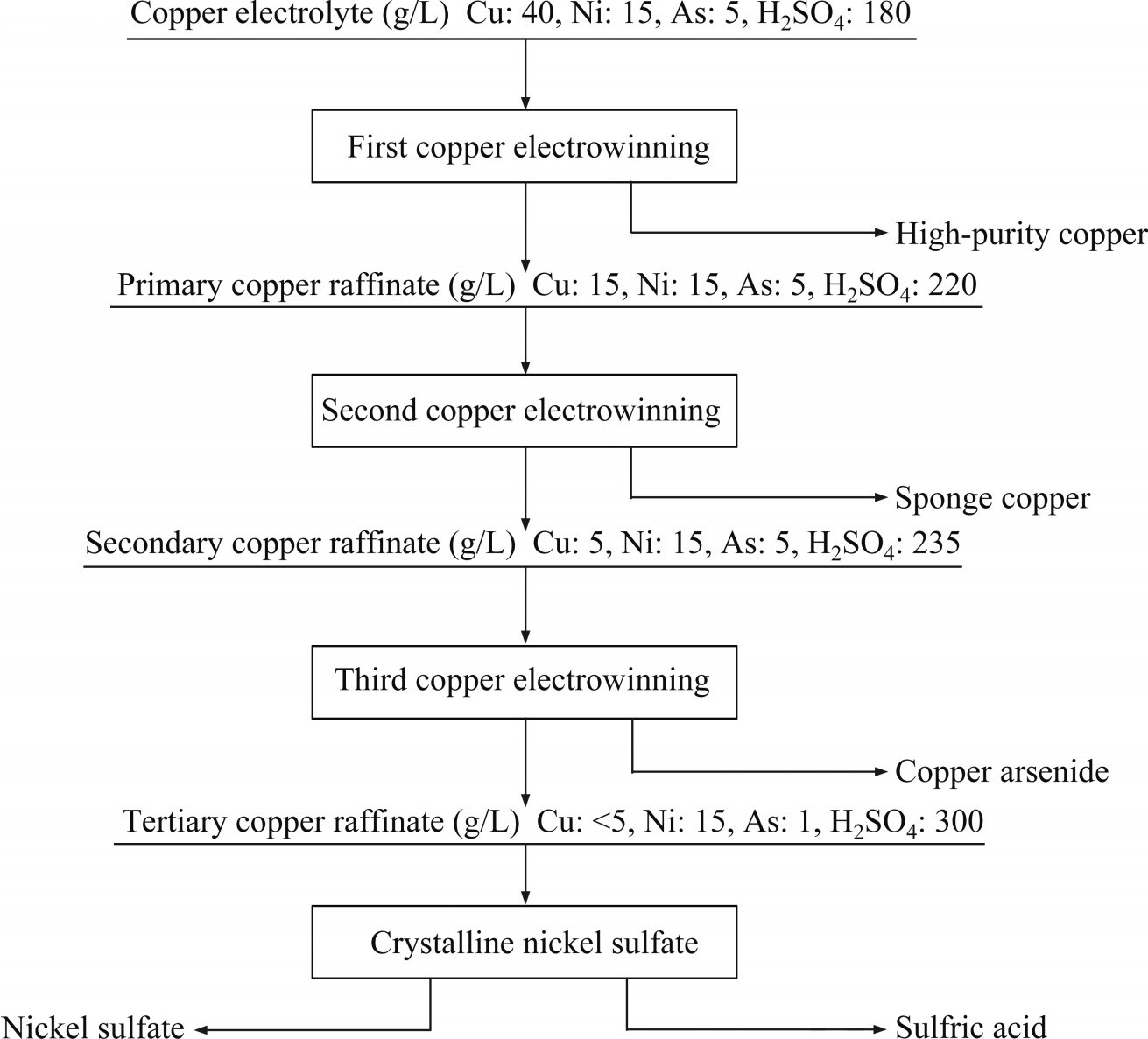
There are many methods for removing arsenic from copper electrolyte, including electrowinning, adsorption, solvent extraction, ion exchange, membrane filtration, and precipitation. In electrowinning, a voltage is applied to an electrolysis cell, causing arsenic and copper to co-deposit at the cathode, thereby removing arsenic. Adsorption involves using an adsorbent to selectively remove arsenic from the electrolyte. Solvent extraction involves adding a specific organic solvent to the electrolyte, which forms a stable complex with arsenic and is subsequently separated from the solution. Ion exchange uses ion exchange resins to selectively remove arsenic from the electrolyte. Membrane filtration separates arsenic species in the solution based on their particle sizes or electrical properties. In the precipitation process, a precipitant is added to the electrolyte, forming insoluble arsenic compounds, which are subsequently removed by filtration. These methods have shown varying degrees of advantages and disadvantages in both laboratory and industrial applications, providing different solutions for copper electrolyte treatment.
Loading authentic research manuscript (Pages 1–5)...
MA Jun, DUAN Ning, XU Fu-yuan, JIANG Lin-hua, XIAO Ke (2025). Arsenic removal in copper electrolyte: A review and future prospects. Journal of Central South University. https://doi.org/10.1007/s11771-025-5977-4
Research & Educational Purpose Only:The translations, structured abstracts, analytical annotations, and data reports provided by SinoTechIntel are intended exclusively for academic research, internal corporate R&D, and educational benchmarking. They do not constitute formal engineering, chemical safety, legal, or professional advice.
Copyright & Intellectual Property Notice: Original copyright of the underlying source articles and experimental data remains with the respective authors, institutions, and original publishing journals. SinoTechIntel claims intellectual property only over its proprietary translations, analytical syntheses, and AEO structured enhancements in accordance with international fair use and academic citation principles.
Frequently Asked Questions
What are the main sources and effects of arsenic in copper electrolyte during electrolytic refining?
During copper electrolytic refining, arsenic originates from impurities in crude copper anodes. It enters the electrolyte and can co-deposit with copper, leading to arsenic inclusions in cathode copper, which degrade its electrical conductivity and mechanical properties. Arsenic also increases anode slime generation, complicates equipment cleaning, causes corrosion, and poses severe environmental and health risks if released untreated.
Which arsenic removal techniques are evaluated in this review?
This review evaluates six arsenic removal technologies: electrowinning, adsorption, solvent extraction, ion exchange, membrane filtration, and precipitation. The methods are compared based on arsenic removal efficiency, cost effectiveness, technical maturity, environmental friendliness, and operational simplicity.
Why is electrowinning considered the most widely used arsenic removal method?
Electrowinning is highlighted as the most widely used and mature arsenic removal technique for copper electrolyte purification. It applies a voltage to an electrolysis cell, causing arsenic and copper to co-deposit at the cathode, thereby removing arsenic from the electrolyte effectively and in an industrially scalable manner.
What are the future prospects for copper electrolyte purification?
Future trends in copper electrolyte purification focus on waste reduction at source, resource utilization, intelligent digitalization, and innovations in materials and processes. These directions aim to improve sustainability, efficiency, and environmental performance of copper refining.
Why is arsenic removal in copper electrolyte economically and socially significant?
Controlling and removing arsenic is critical because it improves the quality and productivity of high-purity copper, protects equipment from corrosion and slime build-up, and prevents toxic arsenic-containing wastes from harming the environment and human health.
Related Technical Papers & Translations

Design and optimization of a high-efficiency distillation process for cellulosic fuel ethanol integrated with thermal coupling and molecular sieve adsorption
To address the challenges of high energy consumption and prominent costs in the traditional three-columns distillation process for cellulosic fuel ethanol, a distillation—molecular sieve coupling separation process is proposed. This process integrates a three-column (crude distillation column, first distillation column, second distillation column) system with a 3A molecular sieve adsorption deep dehydration unit. A thermal coupling network is constructed via differential pressure design (steam from medium/high-pressure columns as mutual heat sources, reboiler liquid waste heat for feed preheating), and molecular sieve adsorption conditions are optimized. The study first performs a thermodynamic consistency test on the ethanol—water system, determines optimal non-random two-liquid (NRTL) model binary interaction parameters via experimental data regression for Aspen Plus simulation. Aiming at minimum total annual cost (TAC), Aspen Plus is used to optimize process parameters (theoretical tray number, feed location, reflux ratio, side-draw position, etc.). Economic analysis shows this process reduces CO2 emission costs by 27.56%, TAC by 15.58% (to 5.123 × 10⁶ USD·a-1), and increases ethanol purity to >99.6%, providing an effective solution for green, efficient separation.

A cohesion loss model for determining residual strength of deep bedded sandstone
Rock residual strength, as an important input parameter, plays an indispensable role in proposing the reasonable and scientific scheme about stope design, underground tunnel excavation and stability evaluation of deep chambers. Therefore, previous residual strength models of rocks established were reviewed. And corresponding related problems were stated. Subsequently, starting from the effects of bedding and whole life-cycle evolution process, series of triaxial mechanical tests of deep bedded s

Federated model with contrastive learning and adaptive control variates for human activity recognition
Recent attention to privacy issues demands a communication-safe method for training human activity recognition (HAR) models on client activity data. Federated learning (FL) has become a compelling technique to facilitate model training between the server and clients while preserving data privacy. However, classical FL methods often assume independent and identically distributed (IID) data among clients. This assumption does not hold true in practical scenarios. Human activity in real-world scena