Key Takeaways & Executive Findings
- •• Introduces a DRO-based active search strategy that builds a robust probabilistic ambiguity set to identify critical security boundary points, balancing uncertainty misestimation and conservatism. • Applies a Transformer-based deep learning model with self-attention to capture global nonlinear dependencies and reconstruct the full high-dimensional security region efficiently. • Demonstrates accurate characterization of security regions on IEEE test systems at low computational cost, with strong robustness to renewable-load uncertainty. • Provides a new data-driven paradigm for power system security assessment and decision support under high renewable uncertainty.
Abstract
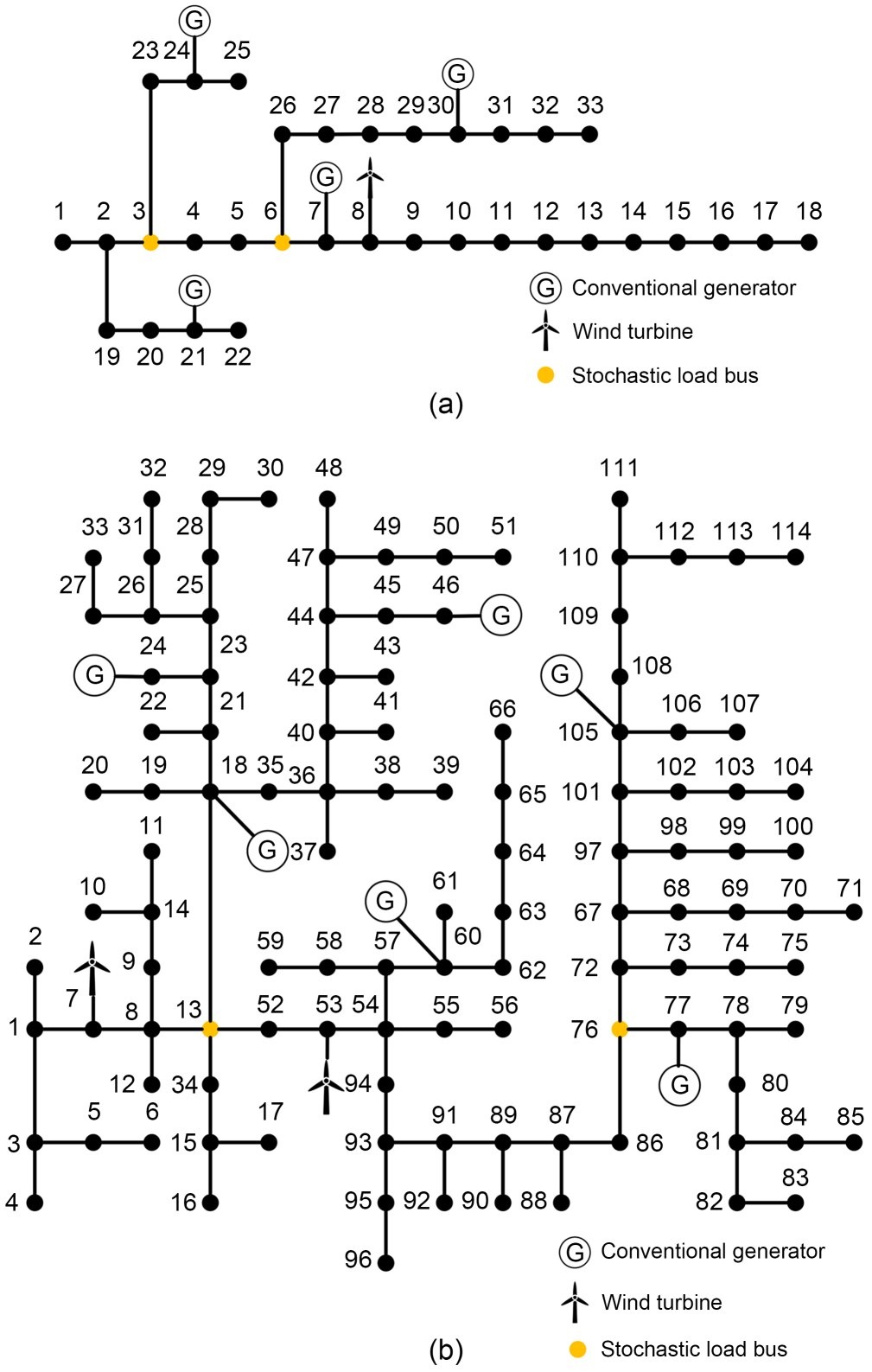
Renewable generation and load uncertainty pose significant challenges to power system security, necessitating efficient approaches to characterizing high-dimensional security regions. To overcome the curse of dimensionality, uncertainty neglect, and undue conservatism in existing methods, this paper proposes an approach integrating distributionally robust optimization (DRO) and deep learning for security region characterization. First, to properly account for uncertainty while avoiding excessive conservatism, a DRO-based active search strategy is developed to identify critical boundary points, where diffusion-generated renewable scenarios and load-deviation samples constructed around typical demand profiles are jointly used to build a robust probabilistic ambiguity set. Subsequently, a Transformer-based model learns from these boundary points to reconstruct the full high-dimensional security region. The model’s self-attention mechanism captures the global nonlinear dependencies among dimensions, enabling a precise and efficient boundary fit. Simulations on IEEE test systems confirm that the approach accurately characterizes high-dimensional security regions at a low computational cost, yielding a security region with strong robustness to renewable-load uncertainty. This work offers a new paradigm for security assessment and decision support in power systems under high uncertainty.
1. Introduction
The secure operation of modern power systems is increasingly challenged by the high penetration of variable and uncertain renewable energy sources (Zhang ZY et al., 2023, 2024; Aryani and Song, 2024). Traditional approaches enforce security conditions as constraints to locate a single optimal operating point, providing no global view of the full set of feasible operating points. As a result, operational margins remain opaque and the geometry of the security boundary is not characterized. Moreover, the coupling between individual operating points and the feasible space is not visually intuitive, making it difficult for operators to develop comprehensive strategies.
To address this need, the power system security region (SR) concept was introduced (Wu F and Kumagai, 1982). The SR defines the set of all operating points that satisfy the power flow equations and operational security constraints, offering system operators a global view of operational margins for decision-making (Teng et al., 2024). SRs are commonly classified into steady-state security regions (SSRs) (Wu F and Kumagai, 1982) which capture static characteristics and dynamic security regions (DSRs) (Wu FF et al., 1988) which account for dynamic processes. Recently, the widespread integration of renewables has profoundly altered grid operating characteristics and reshaped steady-state security boundaries (Jin et al., 2023; Lin et al., 2023; Xiao et al., 2024). Under high renewable uncertainty, the dominant operational risks manifest at the power balance and network flow level on minute-to-hour timescales, making the SSR the primary object for scheduling and flexibility assessment. Consequently, accurate characterization of the SSR remains a central challenge and is the focus of this study. In what follows, SR refers to SSR.
Approaches for the characterization of SR are broadly categorized as analytical and numerical (search-and-fit). Analytical methods derive explicit boundary expressions (Dai et al., 2019; Lin et al., 2021; Su et al., 2021; Tinoco et al., 2021), offering high accuracy. Su et al. (2021) proposed a complete characterization for the SR of electricity-gas integrated energy systems. Without any model simplification, the method reveals that the region possesses complex geometric properties. However, despite high accuracy, their mathematical derivation becomes intractable for modern, high-dimensional, and nonlinear power systems. In contrast, numerical approaches first sample discrete points via vertex search (Nguyen et al., 2019; Monteiro et al., 2020; Avila et al., 2021; Li X et al., 2021; Lin et al., 2022) or point-wise simulation (Liu L et al., 2020; Gao et al., 2023) and then employ techniques like hyperplane fitting (Jiang T et al., 2021; Sun and Yu, 2023; Zhang S et al., 2024) or convex hull (Chen et al., 2019) to construct the SR boundary. Sun and Yu (2023) approximated the SR boundary using the hyperplane method, which linearizes the complex boundary into a set of tractable linear inequalities.
Loading authentic research manuscript (Pages 1–5)...
Yuekai Chen, Zhejing Bao, Miao Yu (2025). An approach to characterizing the power system security region by integrating distributionally robust optimization and Transformer-based deep learning. Engineering Information Technology & Electronic Engineering. https://doi.org/10.1631/ENG_ITEE_2026_0024
Research & Educational Purpose Only:The translations, structured abstracts, analytical annotations, and data reports provided by SinoTechIntel are intended exclusively for academic research, internal corporate R&D, and educational benchmarking. They do not constitute formal engineering, chemical safety, legal, or professional advice.
Copyright & Intellectual Property Notice: Original copyright of the underlying source articles and experimental data remains with the respective authors, institutions, and original publishing journals. SinoTechIntel claims intellectual property only over its proprietary translations, analytical syntheses, and AEO structured enhancements in accordance with international fair use and academic citation principles.
Frequently Asked Questions
What is the main contribution of the paper?
The paper proposes an approach that integrates distributionally robust optimization (DRO) and Transformer-based deep learning to characterize high-dimensional power system security regions efficiently and robustly under renewable-load uncertainty.
How does the method overcome the curse of dimensionality?
Instead of explicitly solving high-dimensional nonlinear boundaries, the method uses DRO-based active search to identify critical boundary points, and then a Transformer model learns from these points via self-attention to reconstruct the full region, enabling efficient and accurate characterization.
What is the role of the DRO-based active search strategy?
The strategy builds a robust probabilistic ambiguity set using diffusion-generated renewable scenarios and load-deviation samples around typical demand profiles, allowing the identification of critical boundary points while balancing uncertainty misestimation and over-conservatism.
Why is the Transformer model advantageous in this context?
The Transformer’s self-attention mechanism captures global nonlinear dependencies among dimensions of the security region, which is a key advantage over conventional hyperplane fitting or convex hull methods that assume linearity or local structure.
Related Technical Papers & Translations
Design and optimization of a high-efficiency distillation process for cellulosic fuel ethanol integrated with thermal coupling and molecular sieve adsorption
To address the challenges of high energy consumption and prominent costs in the traditional three-columns distillation process for cellulosic fuel ethanol, a distillation—molecular sieve coupling separation process is proposed. This process integrates a three-column (crude distillation column, first distillation column, second distillation column) system with a 3A molecular sieve adsorption deep dehydration unit. A thermal coupling network is constructed via differential pressure design (steam from medium/high-pressure columns as mutual heat sources, reboiler liquid waste heat for feed preheating), and molecular sieve adsorption conditions are optimized. The study first performs a thermodynamic consistency test on the ethanol—water system, determines optimal non-random two-liquid (NRTL) model binary interaction parameters via experimental data regression for Aspen Plus simulation. Aiming at minimum total annual cost (TAC), Aspen Plus is used to optimize process parameters (theoretical tray number, feed location, reflux ratio, side-draw position, etc.). Economic analysis shows this process reduces CO2 emission costs by 27.56%, TAC by 15.58% (to 5.123 × 10⁶ USD·a-1), and increases ethanol purity to >99.6%, providing an effective solution for green, efficient separation.
A cohesion loss model for determining residual strength of deep bedded sandstone
Rock residual strength, as an important input parameter, plays an indispensable role in proposing the reasonable and scientific scheme about stope design, underground tunnel excavation and stability evaluation of deep chambers. Therefore, previous residual strength models of rocks established were reviewed. And corresponding related problems were stated. Subsequently, starting from the effects of bedding and whole life-cycle evolution process, series of triaxial mechanical tests of deep bedded s
Federated model with contrastive learning and adaptive control variates for human activity recognition
Recent attention to privacy issues demands a communication-safe method for training human activity recognition (HAR) models on client activity data. Federated learning (FL) has become a compelling technique to facilitate model training between the server and clients while preserving data privacy. However, classical FL methods often assume independent and identically distributed (IID) data among clients. This assumption does not hold true in practical scenarios. Human activity in real-world scena