Key Takeaways & Executive Findings
- •• Proposes an adaptive dung beetle optimizer (ADBO) that integrates an elastic annealing mechanism to overcome premature convergence and poor accuracy. • Introduces a nonlinear decreasing convergence factor to better balance global exploration and local exploitation. • Applies a greedy difference optimization strategy to enhance population diversity and global search capability. • Validates ADBO on CEC 2017, CEC 2022, and MCNC benchmark circuits, demonstrating superior performance over existing approaches.
Abstract
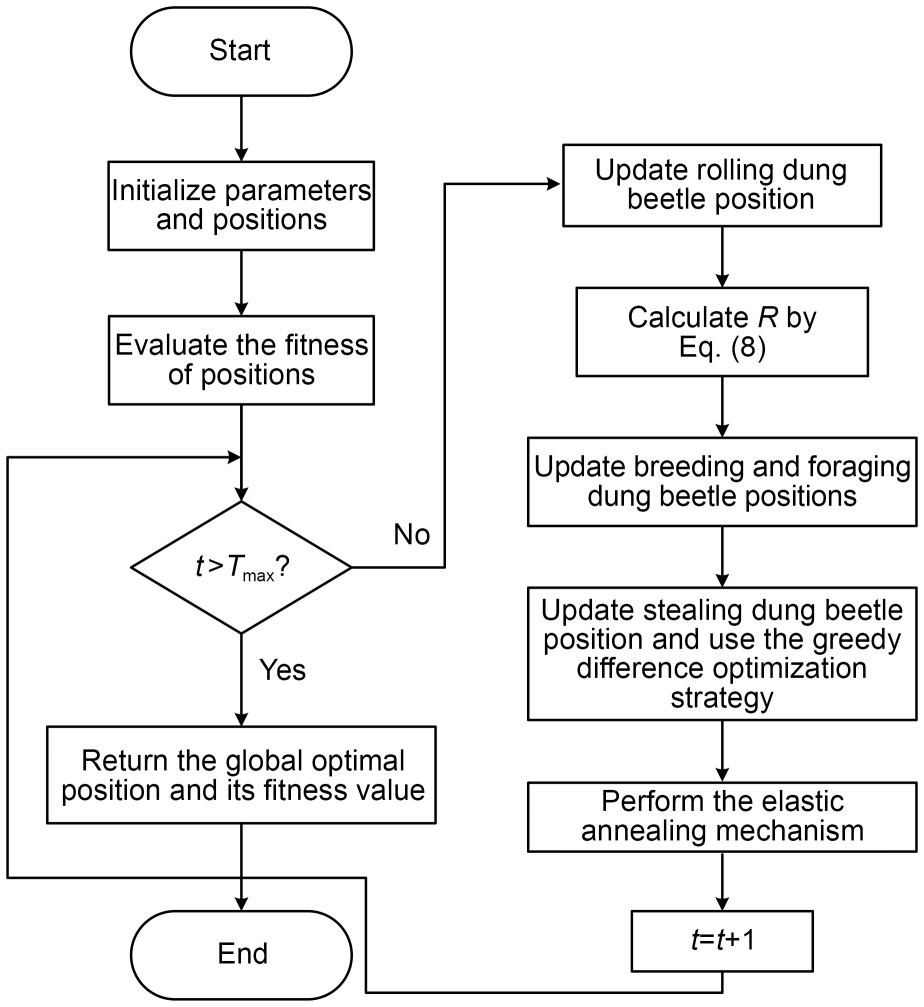
The dung beetle optimizer (DBO) is a metaheuristic algorithm with fast convergence and powerful search capabilities, which has shown excellent performance in solving various optimization problems. However, it suffers from the problems of easily falling into local optimal solutions and poor convergence accuracy when dealing with large-scale complex optimization problems. Therefore, we propose an adaptive DBO (ADBO) based on an elastic annealing mechanism to address these issues. First, the convergence factor is adjusted in a nonlinear decreasing manner to balance the requirements of global exploration and local exploitation, thus improving the convergence speed and search quality. Second, a greedy difference optimization strategy is introduced to increase population diversity, improve the global search capability, and avoid premature convergence. Finally, the elastic annealing mechanism is used to perturb the randomly selected individuals, helping the algorithm escape local optima and thereby improve solution quality and algorithm stability. The experimental results on the CEC 2017 and CEC 2022 benchmark function sets and MCNC benchmark circuits verify the effectiveness, superiority, and universality of ADBO.
1. Introduction
Optimization problems are prevalent in real life and engineering applications that are widely used in areas such as resource allocation, financial portfolio optimization, intelligent transportation (Han et al., 2024), drone path planning (Amores et al., 2024), and supply chain management (Li J et al., 2023). Metaheuristic algorithms, inspired by natural phenomena (e.g., biological evolution and physical dynamics), have emerged as mainstream solutions for complex optimization tasks, particularly in high-dimensional or uncertain problem spaces (Ali et al., 2015; Ikram et al., 2023).
These algorithms simulate natural processes (e.g., evolutionary mechanisms or collective behaviors) to approximate global optimal solutions. Their core strengths include robust global search to avoid local optima, flexibility without strict mathematical formulations, and inherent parallelism for scalability. Metaheuristic algorithms are broadly classified into four categories based on design principles: evolutionary algorithms (e.g., genetic algorithm (GA) (Grefenstette, 1993), differential evolution (DE) (Storn and Price, 1997), and cultural algorithm (CA) (Reynolds and Peng, 2004)), which mimic biological evolution using mechanisms such as selection, mutation, and social learning; swarm-based algorithms (e.g., artificial rabbits optimization (ARO) (Wang LY et al., 2022), tunicate swarm algorithm (TSA) (Kaur et al., 2020), and mountain gazelle optimizer (MGO) (Abdollahzadeh et al., 2022)), which are inspired by collective animal behaviors and address multimodal or high-dimensional optimization; physics-based algorithms (e.g., simulated annealing (SA) mechanism (Kirkpatrick et al., 1983), thermal exchange optimization (TEO) (Kaveh and Dadras, 2017), and gravitational search algorithm (GSA) (Rashedi et al., 2009)), which leverage natural phenomena such as thermodynamics and gravitational interactions for global search.
Loading authentic research manuscript (Pages 1–5)...
Lixin MIAO, Zhenxue HE, Xiaojun ZHAO, Yijin WANG, Xiaodan ZHANG, Kui YU, Limin XIAO, Zhisheng HUO (2025). An adaptive dung beetle optimizer based on an elastic annealing mechanism and its application to numerical problems and optimization of Reed–Muller logic circuits. Frontiers of Information Technology & Electronic Engineering. https://doi.org/10.1631/FITEE_2400967
Research & Educational Purpose Only:The translations, structured abstracts, analytical annotations, and data reports provided by SinoTechIntel are intended exclusively for academic research, internal corporate R&D, and educational benchmarking. They do not constitute formal engineering, chemical safety, legal, or professional advice.
Copyright & Intellectual Property Notice: Original copyright of the underlying source articles and experimental data remains with the respective authors, institutions, and original publishing journals. SinoTechIntel claims intellectual property only over its proprietary translations, analytical syntheses, and AEO structured enhancements in accordance with international fair use and academic citation principles.
Frequently Asked Questions
What is an adaptive dung beetle optimizer (ADBO)?
ADBO is an enhanced version of the dung beetle optimizer (DBO) that integrates an elastic annealing mechanism to overcome DBO's drawbacks, such as premature convergence and poor convergence accuracy on large-scale complex optimization problems.
How does the elastic annealing mechanism improve the algorithm?
The elastic annealing mechanism perturbs randomly selected individuals, helping the algorithm escape local optima. This improves solution quality and algorithm stability while maintaining a balance between exploration and exploitation.
What benchmark tests were used to evaluate ADBO?
The proposed ADBO was validated on the CEC 2017 and CEC 2022 benchmark function sets, as well as MCNC benchmark circuits, demonstrating its effectiveness, superiority, and universality across diverse optimization problems.
What are the main contributions of this paper?
The paper contributes three key improvements to DBO: a nonlinear decreasing convergence factor, a greedy difference optimization strategy, and an elastic annealing mechanism. These collectively enhance convergence speed, population diversity, and global search capability.
What is the practical significance of this research?
ADBO offers a robust and efficient metaheuristic algorithm for solving complex optimization problems, particularly in high-dimensional and multimodal spaces. Its application to Reed-Muller logic circuit optimization highlights its potential in real-world engineering design.
Related Technical Papers & Translations
Design and optimization of a high-efficiency distillation process for cellulosic fuel ethanol integrated with thermal coupling and molecular sieve adsorption
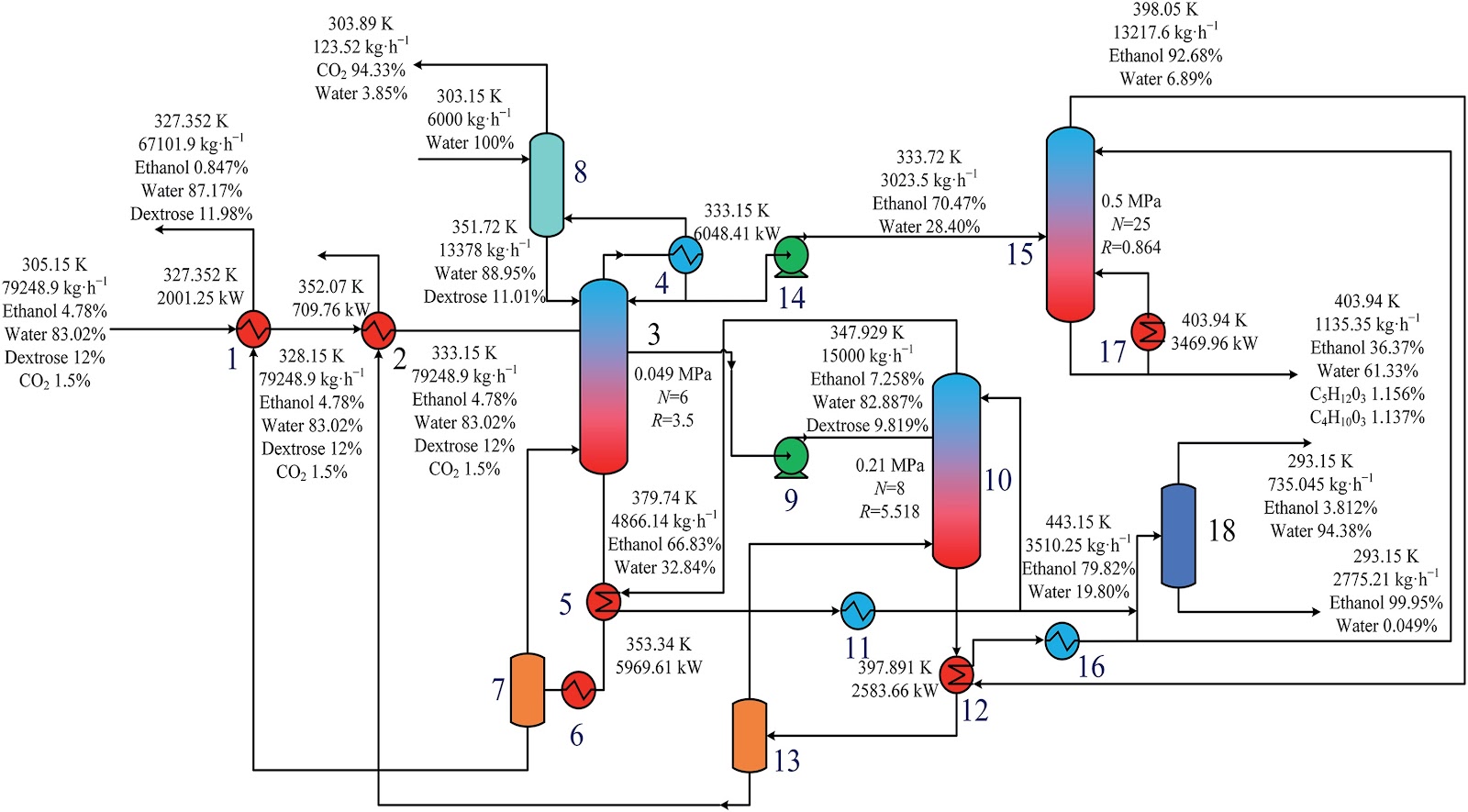
To address the challenges of high energy consumption and prominent costs in the traditional three-columns distillation process for cellulosic fuel ethanol, a distillation—molecular sieve coupling separation process is proposed. This process integrates a three-column (crude distillation column, first distillation column, second distillation column) system with a 3A molecular sieve adsorption deep dehydration unit. A thermal coupling network is constructed via differential pressure design (steam from medium/high-pressure columns as mutual heat sources, reboiler liquid waste heat for feed preheating), and molecular sieve adsorption conditions are optimized. The study first performs a thermodynamic consistency test on the ethanol—water system, determines optimal non-random two-liquid (NRTL) model binary interaction parameters via experimental data regression for Aspen Plus simulation. Aiming at minimum total annual cost (TAC), Aspen Plus is used to optimize process parameters (theoretical tray number, feed location, reflux ratio, side-draw position, etc.). Economic analysis shows this process reduces CO2 emission costs by 27.56%, TAC by 15.58% (to 5.123 × 10⁶ USD·a-1), and increases ethanol purity to >99.6%, providing an effective solution for green, efficient separation.
A cohesion loss model for determining residual strength of deep bedded sandstone
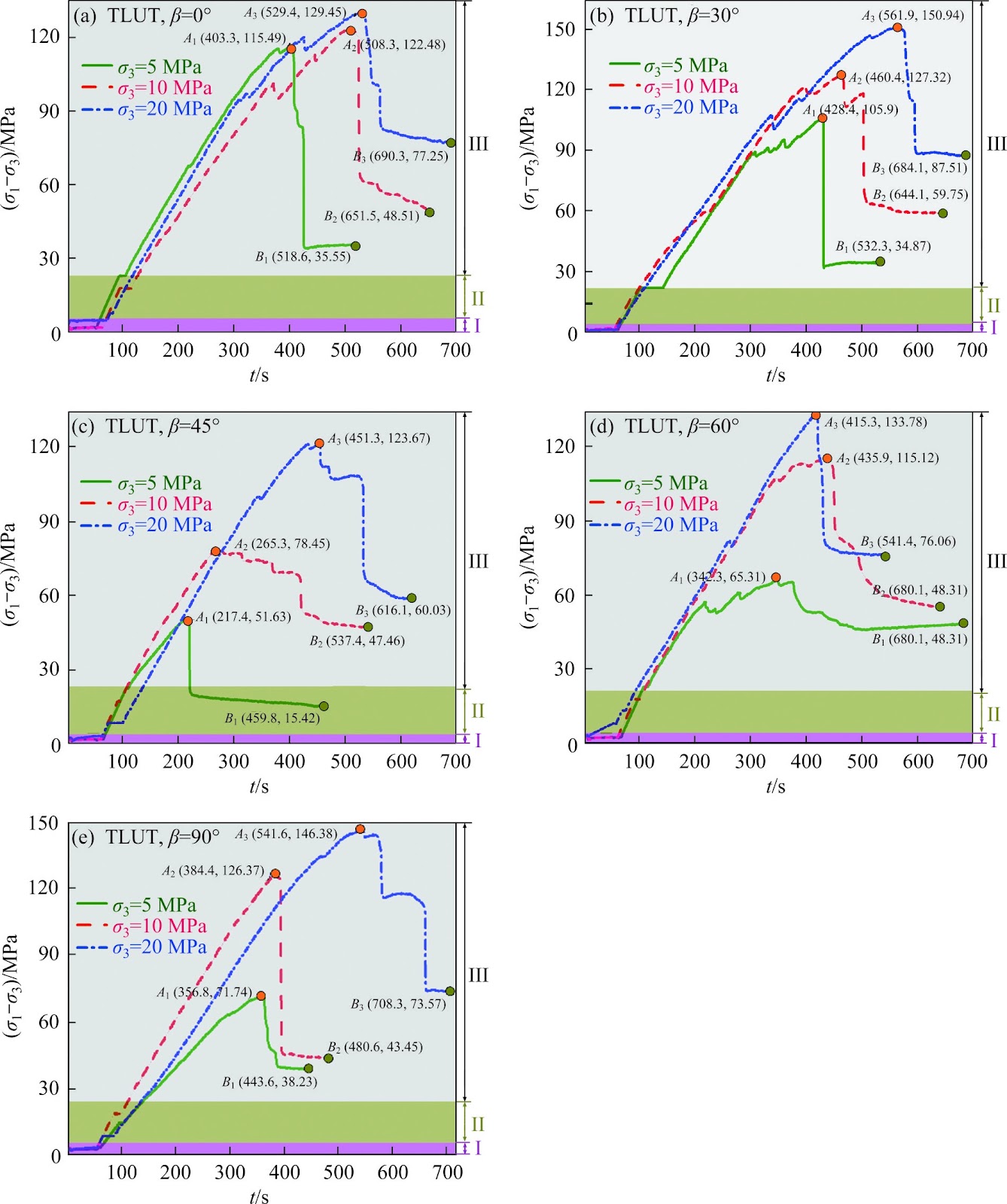
Rock residual strength, as an important input parameter, plays an indispensable role in proposing the reasonable and scientific scheme about stope design, underground tunnel excavation and stability evaluation of deep chambers. Therefore, previous residual strength models of rocks established were reviewed. And corresponding related problems were stated. Subsequently, starting from the effects of bedding and whole life-cycle evolution process, series of triaxial mechanical tests of deep bedded s
Federated model with contrastive learning and adaptive control variates for human activity recognition
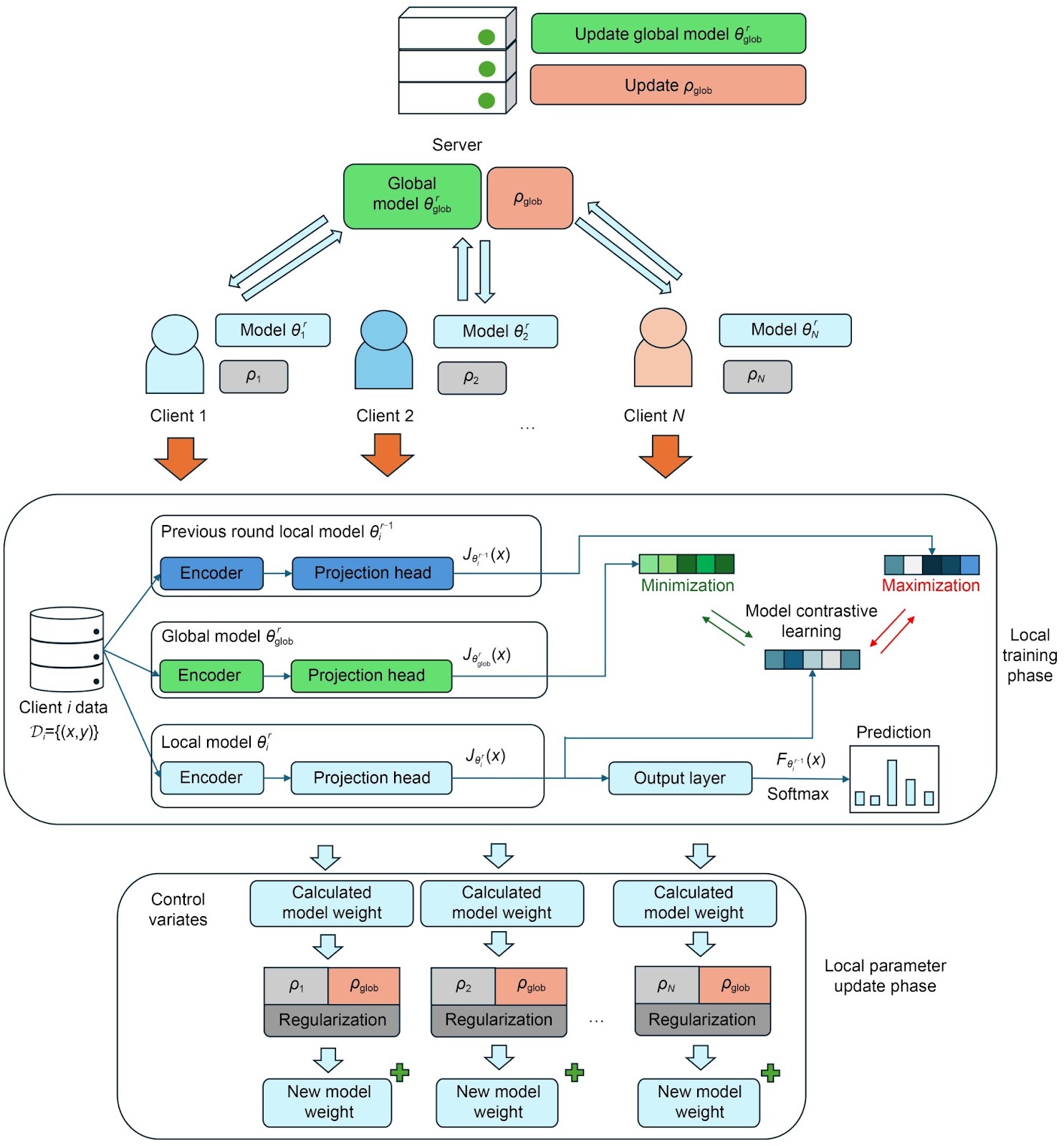
Recent attention to privacy issues demands a communication-safe method for training human activity recognition (HAR) models on client activity data. Federated learning (FL) has become a compelling technique to facilitate model training between the server and clients while preserving data privacy. However, classical FL methods often assume independent and identically distributed (IID) data among clients. This assumption does not hold true in practical scenarios. Human activity in real-world scena