Key Takeaways & Executive Findings
- •• Nanodiamond (ND) offers exceptional chemical stability, high charge carrier mobility, and versatile surface functionalization, positioning it as a promising photocatalyst platform. • Strategies such as surface functionalization, plasmonic hybridization, heteroatom doping, and heterostructure design effectively extend ND's light absorption into the visible range and enhance charge separation. • The structure-activity relationship and design principles for ND-based photocatalysts focus on optimizing light harvesting, charge transport, and redox kinetics. • ND-based photocatalysts show significant potential for solar fuel production (H2, CO2 reduction) and environmental remediation, addressing limitations of conventional photocatalysts.
Abstract
Photocatalysis is an important technology for using solar energy to produce hydrogen, convert CO2 to synthetic fuels, and decrease persistent pollutant. However, conventional photocatalysts have limitations, including poor spectral absorption, inefficient charge separation, and structural instability under operational stress, which demand innovative durable materials with tailored electronic properties. Nanodiamond (ND) has recently been recognized as a suitable material because of its exceptional chemical stability, superior charge carrier mobility, and possible surface functionalization. While its intrinsic wide bandgap limits its response to visible-light, different methods have been demonstrated to activate its catalytic potential. Here, several emerging strategies for improving the catalytic performance of ND-based photocatalytic systems are summarized, including surface functionalization, plasmonic hybridization, heteroatom doping, and heterostructure design. And the structure-activity relationship and design principle are proposed to improve the light harvesting, charge transport, and redox kinetics for constructing high efficiency ND-based photocatalysts used in the renewable energy and environmental industries.
1. Introduction
The direct and effective utilization of solar energy has become a key component of sustainable fields, such as photocatalysis, thermal catalysis, photovoltaic and photothermal power generation[1–3]. Photocatalysis, which mimics natural photosynthesis by leveraging semiconductors to drive redox reactions under light irradiation, has emerged as a cornerstone technology for solar energy cycles[4–8]. Its applications span 3 critical domains: (1) solar water splitting for hydrogen production[9–13]; (2) CO2 photoreduction to value-added hydrocarbons[14–18]; (3) environmental remediation via radical-mediated pollutant degradation[19–21]. The International Energy Agency asserts that hydrogen and hydrogen-based fuels play a pivotal role in achieving net-zero emissions.
Unfortunately, traditional semiconductor photocatalysts face multiple key challenges due to their inherent limitations in practical applications. Most photocatalysts possess wide band gap (Eg), rendering them capable of excitation solely by ultraviolet (UV) or near UV light. For example, ZnO (3.3 eV) and TiO2 (3.2 eV) have wide bandgaps, and can utilize only 4% of the solar energy in the UV[22–23]. While doping (e.g., N, S) or defect engineering can extend the absorption edge into the visible region[24], such modifications frequently result in an augmentation of carrier recombination centers, consequently diminishing quantum efficiency. Furthermore, the energy conversion efficiency is severely constrained by inadequate charge separation, electron–hole recombination and slow transport, as well as sluggish interfacial reactions. Meanwhile, concerns regarding thermal, hydrothermal, and chemical stability have the potential to jeopardize the photocatalytic lifetime, a predicament in practical applications. Additionally, the presence of toxic deactivation in photocatalysts represents a critical defect in photocatalytic applications[25]. These limitations necessitate advanced materials with broad light absorption, efficient charge separation, and robust stability.
Nanodiamond (ND) has arisen as a revolutionary catalytic platform, uniquely positioned to overcome conventional semiconductor limitations through distinguished structural and electronic properties[26]. As prototypical zero-dimensional carbon nanomaterials (diameter of 1–100 nm), NDs feature a sp3-hybridized tetrahedral lattice that confers remarkable core properties.
Loading authentic research manuscript (Pages 1–5)...
ZHANG Wan, CHENG Xiangxiang, GUO Kesheng, ZHANG Hansong, LI Lanxiao, ZHAO Yongbing, ZHU Jiaqi, WANG Yongjie (2025). A review of nanodiamond-based photocatalysts for solar energy conversion. SinoTechIntel Verified Research. https://doi.org/10.1016/S1872-5805(NCM2026-41-01-02)
Research & Educational Purpose Only:The translations, structured abstracts, analytical annotations, and data reports provided by SinoTechIntel are intended exclusively for academic research, internal corporate R&D, and educational benchmarking. They do not constitute formal engineering, chemical safety, legal, or professional advice.
Copyright & Intellectual Property Notice: Original copyright of the underlying source articles and experimental data remains with the respective authors, institutions, and original publishing journals. SinoTechIntel claims intellectual property only over its proprietary translations, analytical syntheses, and AEO structured enhancements in accordance with international fair use and academic citation principles.
Frequently Asked Questions
What are the main limitations of conventional photocatalysts?
Conventional photocatalysts like TiO2 and ZnO have wide bandgaps, limiting their activity to UV light, which is only about 4% of solar energy. They also suffer from inefficient charge separation, rapid electron-hole recombination, and poor stability under operational conditions.
Why is nanodiamond considered a promising photocatalyst material?
Nanodiamond offers exceptional chemical stability, high charge carrier mobility, and the ability to be surface-functionalized. Its wide bandgap can be tuned through various strategies to enhance visible-light absorption, making it a versatile platform for solar energy conversion.
What strategies are used to improve the photocatalytic performance of nanodiamond?
Key strategies include surface functionalization, plasmonic hybridization with noble metals, heteroatom doping (e.g., nitrogen, boron), and construction of heterostructures with other semiconductors. These approaches enhance light absorption, charge separation, and redox kinetics.
What are the main applications of nanodiamond-based photocatalysts?
They are used for solar water splitting to produce hydrogen, CO2 photoreduction to synthetic fuels, and degradation of persistent pollutants in environmental remediation.
What is the significance of the structure-activity relationship in ND-based photocatalysts?
Understanding the structure-activity relationship helps in designing photocatalysts with optimized light harvesting, efficient charge transport, and improved redox kinetics, leading to higher overall photocatalytic efficiency.
Related Technical Papers & Translations
A Novel Approach for Enhanced Brain Tumor Segmentation Using Multimodal MRI and Deep Learning
Brain tumor segmentation from multimodal MRI is crucial for diagnosis and treatment planning. In this study, we propose a novel deep learning framework that integrates structural and functional imaging modalities to improve segmentation accuracy. Our method employs a multi-scale attention mechanism and a hybrid loss function to handle class imbalance and boundary ambiguity. Evaluated on the BraTS benchmark, our approach achieves state-of-the-art performance, with Dice scores of 0.91, 0.87, and 0.84 for whole tumor, core, and enhancing tumor, respectively. Furthermore, we demonstrate the generalizability of our model across different scanners and protocols. Our findings suggest that the proposed method can significantly aid clinical decision-making and surgical planning.
Investigation of coupled acoustic and electrical responses and early warning approaches during re-loading of damaged coal
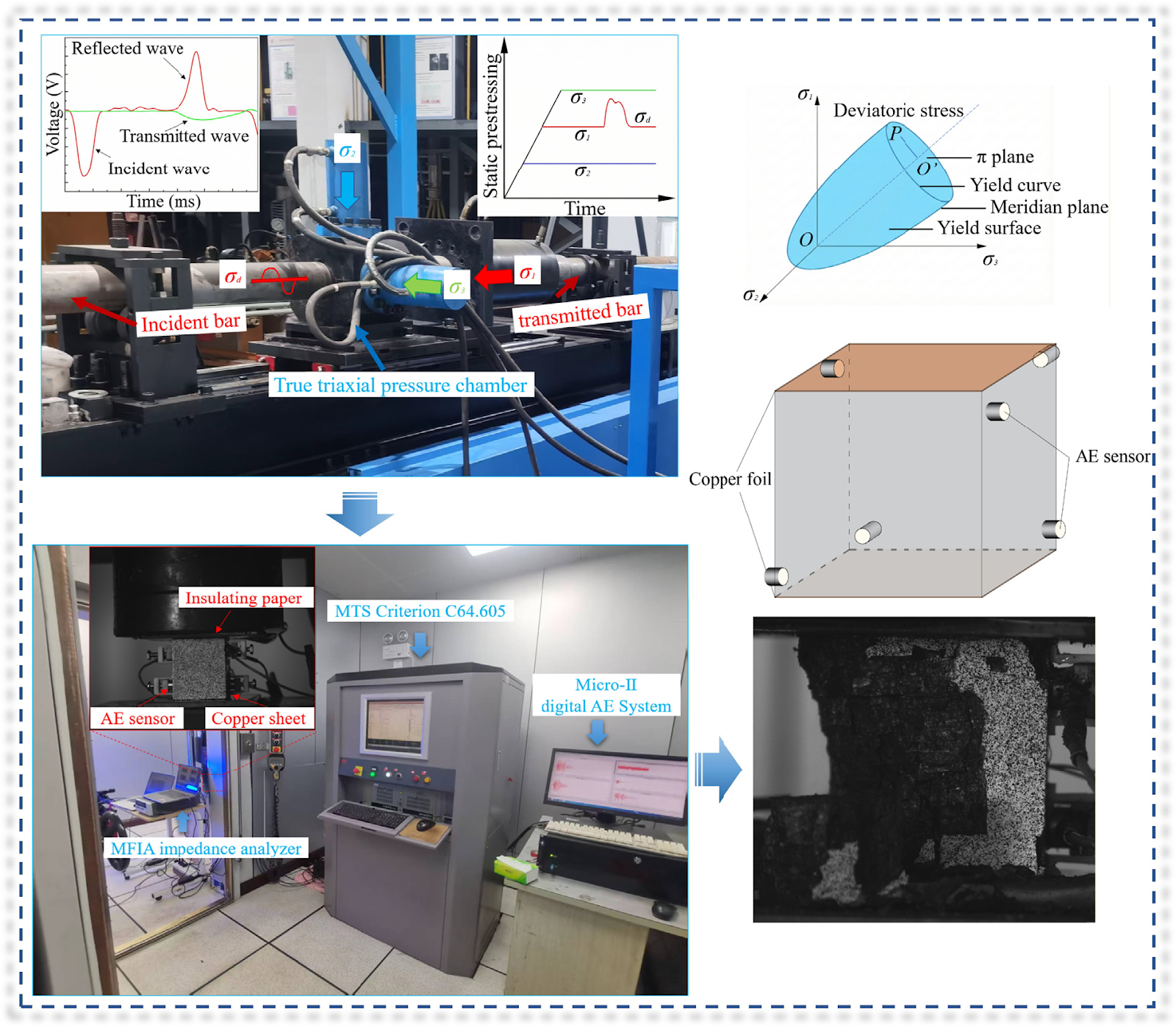
Initial damage from engineering disturbances in deep coal mining degrades mechanical properties and heightens dynamic-hazard risks, challenging conventional monitoring. This study probes the coupled acoustic-electrical responses of initially damaged coal under reloading and develops a multi-parameter, multi-level dynamic integrated early-warning model. Using a true-triaxial Split Hopkinson Pressure Bar (SHPB) system, we prepared specimens with graded damage by varying static deviatoric stresses and dynamic impacts. Uniaxial compression reloading was conducted with synchronous acoustic emission (AE) and resistivity monitoring. Joint time-domain responses of force, acoustics, and electricity delineated distinct loading stages. Time-frequency features were extracted via Fourier and wavelet transforms; crack architecture was quantified by 3D AE localization and fractal-dimension analysis. Initial damage markedly reduced load-bearing capacity. Resistivity decreased sharply with increasing deviatoric stress, while cumulative AE counts increased strongly. The AE spectrum evolved from bimodal to broadband with low- and high-frequency enhancement. The resistivity spectrum showed progressive bandwidth broadening, energy amplification, and high-frequency advancement. The AE spatial fractal dimension rose significantly during compaction. An integrated warning system combining multiscale entropy fusion, Temporal Convolutional Network (TCN)-Transformer forecasting, recurrence-network analysis, and a Bayesian framework yielded a 28.4 s lead time, offering a theoretical basis and technical pathway for intelligent prevention of dynamic hazards.
Influence of aggregate particle size on fracture behavior and energy evolution of cemented rockfill in the post-peak stage
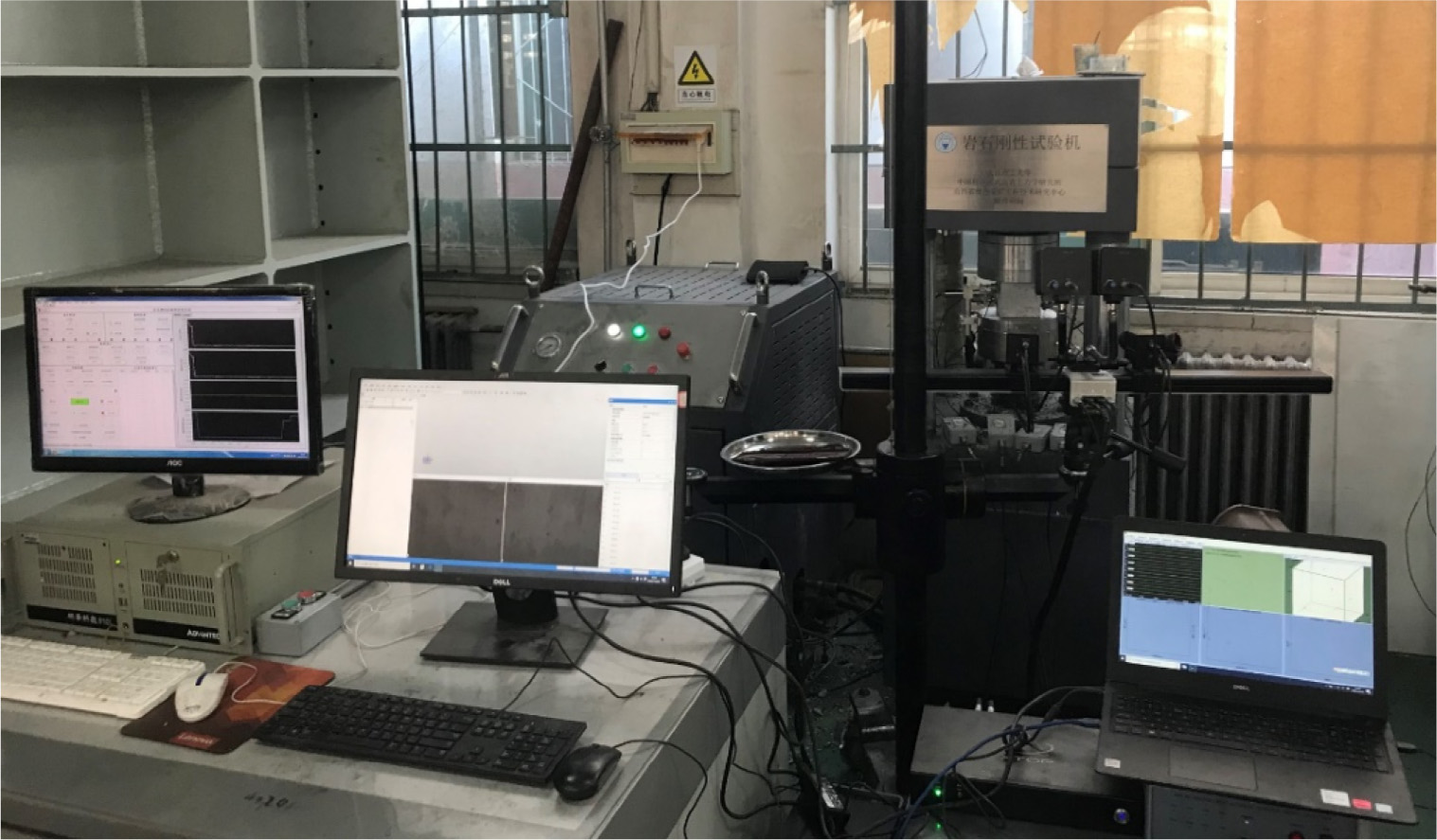
Cemented rockfill (CRF) combines structural support with sustainable reuse of coal-derived solid waste. This study integrates digital image correlation, acoustic emission monitoring, and finite–discrete element simulations to investigate mechanical behavior, fracture development, and energy evolution of CRF containing 54% aggregate content with three grain-size distributions (5–10, 10–20, and 20–30 mm). Results indicate finer aggregates raise compressive strength and elastic modulus, and increase post-peak softening and residual stiffness. Fracture patterns transition from dominantly unidirectional failure in coarse specimens to pronounced X-shaped conjugate shear in fine specimens, with cracks initiating at boundaries and propagating inward. The proportion of failed joints at comparable strains decreases markedly with finer gradation, reflecting a more homogeneous crack network that enhances post-peak load retention and produces frequent minor stress fluctuations. Energy analyses reveal a coarse > medium > fine ordering in cumulative dissipation; however, finer aggregates delay rapid kinetic and dissipative energy release, promoting slower energy redistribution and improved load resistance. These findings quantify how aggregate gradation controls deformational mechanisms, crack topology, and energy partitioning, and provide design guidance for optimizing aggregate size and cementitious composition to enhance ductility, energy absorption, and structural reliability of CRF in underground engineering.