Key Takeaways & Executive Findings
- •• A novel asymptotic linear method (ALM) is proposed to mitigate micro-pressure waves by achieving a constant gradient of the initial compression wave. • The MPW amplitude initially decreases and then rises with increasing tunnel hood open ratio, with an optimal open ratio of 2.28%. • The ALM reduces MPW amplitude by 26.9% at 20 m and 20.0% at 50 m from the tunnel exit compared with an unvented hood. • The method enables rapid determination of the upper mitigation limit and supports adaptive design of tunnel hoods for high-speed maglev operations.
Abstract
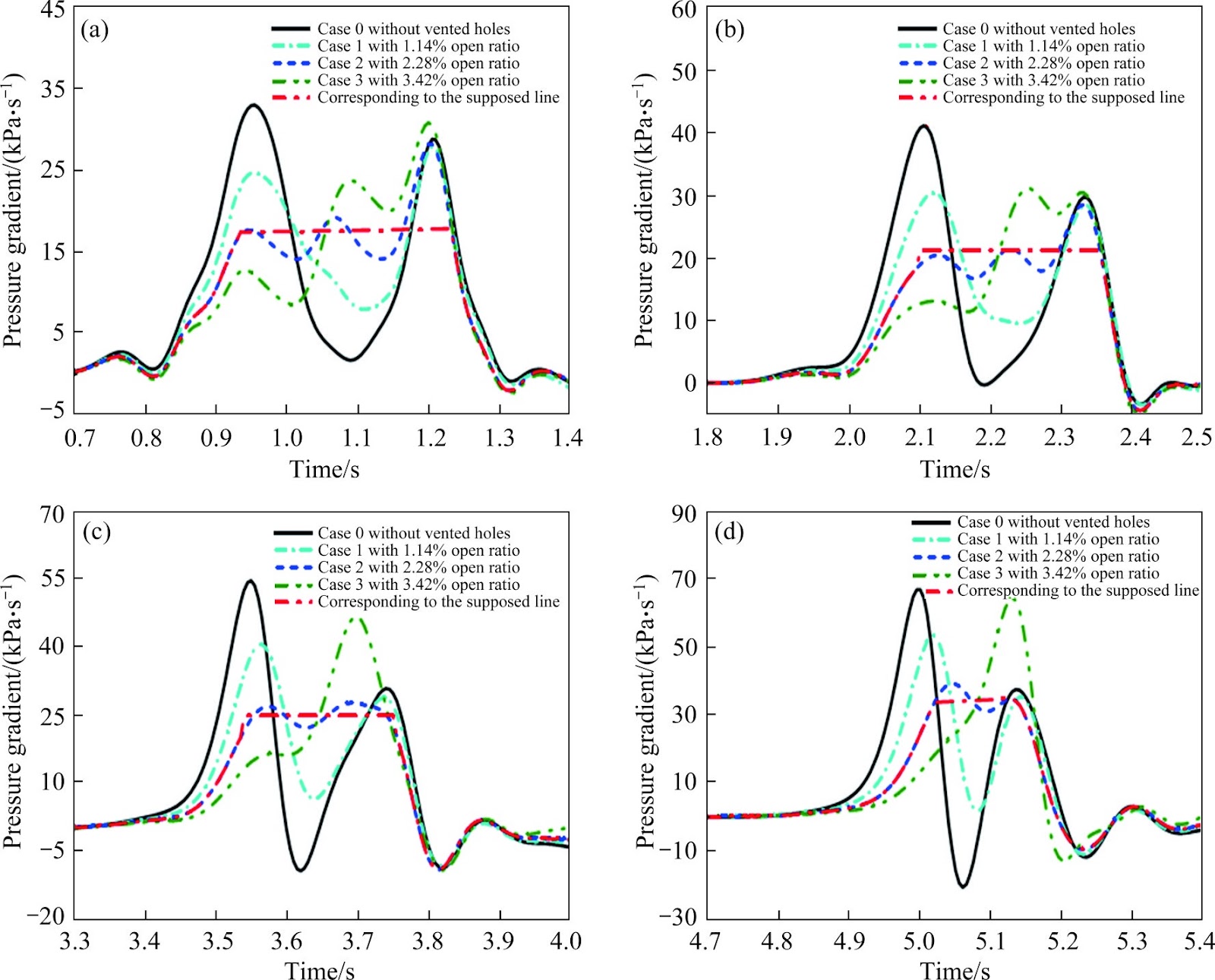
A high-speed train travelling from the open air into a narrow tunnel will cause the "sonic boom" at tunnel exit. When the maglev train's speed reaches 600 km/h, the train-tunnel aerodynamic effect is intensified, so a new mitigation method is urgently expected to be explored. This study proposed a novel asymptotic linear method (ALM) for micro-pressure wave (MPW) mitigation to achieve a constant gradient of initial compression waves (ICWs), via a study with various open ratios on hoods. The properties of ICWs and MPWs under various open ratios of hoods were analyzed. The results show that as the open ratio increases, the MPW amplitude at the tunnel exit initially decreases before rising. At the open ratio of 2.28%, the slope of the ICW curve is linearly coincident with a supposed straight line in the ALM, which further reduces the MPW amplitude by 26.9% at 20 m and 20.0% at 50 m from the exit, as compared to the unvented hood. Therefore, the proposed method effectively mitigates MPW and quickly determines the upper limit of alleviation for the MPW amplitude at a fixed train-tunnel operation condition. All achievements provide a new potential measure for the adaptive design of tunnel hoods.
1. Introduction
High-speed maglev trains have achieved significant breakthroughs in recent years, with the Japanese L0 series reaching 603 km/h in 2015 and the Chinese 600 km/h high-speed maglev train unveiled in 2019. As operating speeds increase, aerodynamic effects become critically important, particularly when a maglev train suddenly enters a narrow tunnel from open air.
When the train enters the tunnel, the airflow ahead of the train head is compressed, generating an initial compression wave (ICW) that propagates to the tunnel exit at the speed of sound. Part of the wave reflects as an expansion wave, causing pressure fluctuations that threaten tunnel structure, train surface integrity, and passenger comfort. The remaining part radiates outward as a micro-pressure wave (MPW), which can induce vibration damage to nearby buildings and noise pollution in residential areas.
Research by Zhang's group at Central South University observed that pressure wave peaks inside tunnels increase sharply at maglev speeds of 400–600 km/h, with a power-law exponent of 5 relating speed to pressure amplitude. Therefore, mitigating excessive MPW at tunnel exits is an urgent engineering challenge for 600 km/h maglev operations.
Loading authentic research manuscript (Pages 1–5)...
ZHANG Jie (张洁), ZHANG Mo-lin (张墨林), HAN Shuai (韩帅), LIU Tang-hong (刘堂红), GAO Guang-jun (高广军) (2025). A novel asymptotic linear method for micro-pressure wave mitigation at high-speed maglev tunnel exit: A case study with various open ratios on tunnel hoods. Journal of Central South University. https://doi.org/10.1007/s11771-025-5900-z
Research & Educational Purpose Only:The translations, structured abstracts, analytical annotations, and data reports provided by SinoTechIntel are intended exclusively for academic research, internal corporate R&D, and educational benchmarking. They do not constitute formal engineering, chemical safety, legal, or professional advice.
Copyright & Intellectual Property Notice: Original copyright of the underlying source articles and experimental data remains with the respective authors, institutions, and original publishing journals. SinoTechIntel claims intellectual property only over its proprietary translations, analytical syntheses, and AEO structured enhancements in accordance with international fair use and academic citation principles.
Frequently Asked Questions
What is the novel asymptotic linear method (ALM) for micro-pressure wave mitigation?
The ALM is a proposed method to mitigate micro-pressure waves at high-speed maglev tunnel exits by achieving a constant gradient of the initial compression wave (ICW). It helps determine the upper limit of MPW amplitude reduction for a fixed train-tunnel operating condition, enabling the adaptive design of tunnel hoods.
How does the open ratio of a tunnel hood affect the micro-pressure wave amplitude?
As the open ratio increases, the MPW amplitude at the tunnel exit first decreases and then rises. The optimal open ratio in this study was 2.28%, where the slope of the ICW curve became linearly coincident with the ALM reference line, yielding the greatest MPW reduction.
What were the key quantitative reductions observed with the ALM?
At the optimal open ratio of 2.28%, the ALM reduced the micro-pressure wave amplitude by 26.9% at 20 m and 20.0% at 50 m from the tunnel exit, compared with an unvented hood.
Why is micro-pressure wave mitigation critical for high-speed maglev tunnels?
At speeds like 600 km/h, the train-tunnel aerodynamic effect intensifies sharply. The generated micro-pressure wave can cause vibration damage to buildings near the tunnel exit and noise pollution in residential areas, so effective mitigation is essential for safety and comfort.
How can tunnel hoods be adaptively designed based on this study?
The study provides a new potential measure for adaptive tunnel hood design by linking the open ratio to MPW amplitude. Engineers can use the ALM to quickly evaluate the maximum possible MPW alleviation and select hood configurations that maintain a constant ICW gradient, leading to optimized open ratios.
Related Technical Papers & Translations

Design and optimization of a high-efficiency distillation process for cellulosic fuel ethanol integrated with thermal coupling and molecular sieve adsorption
To address the challenges of high energy consumption and prominent costs in the traditional three-columns distillation process for cellulosic fuel ethanol, a distillation—molecular sieve coupling separation process is proposed. This process integrates a three-column (crude distillation column, first distillation column, second distillation column) system with a 3A molecular sieve adsorption deep dehydration unit. A thermal coupling network is constructed via differential pressure design (steam from medium/high-pressure columns as mutual heat sources, reboiler liquid waste heat for feed preheating), and molecular sieve adsorption conditions are optimized. The study first performs a thermodynamic consistency test on the ethanol—water system, determines optimal non-random two-liquid (NRTL) model binary interaction parameters via experimental data regression for Aspen Plus simulation. Aiming at minimum total annual cost (TAC), Aspen Plus is used to optimize process parameters (theoretical tray number, feed location, reflux ratio, side-draw position, etc.). Economic analysis shows this process reduces CO2 emission costs by 27.56%, TAC by 15.58% (to 5.123 × 10⁶ USD·a-1), and increases ethanol purity to >99.6%, providing an effective solution for green, efficient separation.

A cohesion loss model for determining residual strength of deep bedded sandstone
Rock residual strength, as an important input parameter, plays an indispensable role in proposing the reasonable and scientific scheme about stope design, underground tunnel excavation and stability evaluation of deep chambers. Therefore, previous residual strength models of rocks established were reviewed. And corresponding related problems were stated. Subsequently, starting from the effects of bedding and whole life-cycle evolution process, series of triaxial mechanical tests of deep bedded s

Federated model with contrastive learning and adaptive control variates for human activity recognition
Recent attention to privacy issues demands a communication-safe method for training human activity recognition (HAR) models on client activity data. Federated learning (FL) has become a compelling technique to facilitate model training between the server and clients while preserving data privacy. However, classical FL methods often assume independent and identically distributed (IID) data among clients. This assumption does not hold true in practical scenarios. Human activity in real-world scena