Key Takeaways & Executive Findings
- •• Introduces a flexible S-shaped damage evolution model based on an improved Logistic function that captures the full damage process during rock deformation—maintenance, onset, acceleration, deceleration, and termination—in a unified expression. • Establishes a constitutive model integrating damage mechanics and effective medium theory that accurately describes complete pre-peak compaction and post-peak strain softening behavior across multiple rock types. • Validated against uniaxial and trial compression tests on Miluo granite, yellow sandstone, mudstone, and glutenite, demonstrating close agreement between theoretical curves and experimental data and significant advantages over existing models. • The damage model parameters a, r, and β have clear physical meanings and competitive interactions, jointly controlling the shape of the theoretical stress-strain curve and enabling practical calibration for engineering applications.
Abstract
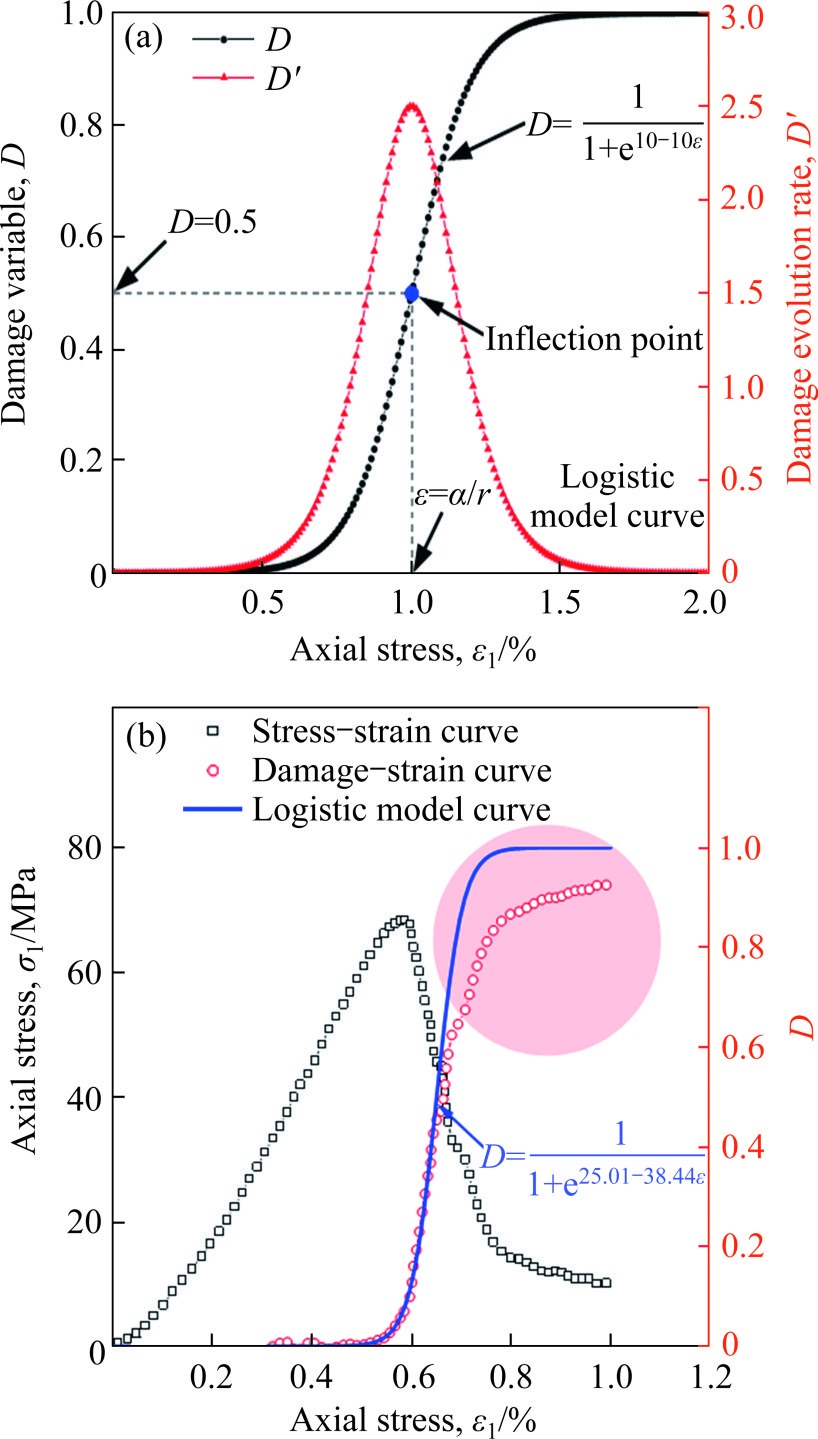
This study proposed a new and more flexible S-shaped rock damage evolution model from a phenomenological perspective based on an improved Logistic function to describe the characteristics of the rock strain softening and damage process. Simultaneously, it established a constitutive model capable of describing the entire process of rock pre-peak compaction and post-peak strain softening deformation, considering the nonlinear effects of the initial compaction stage of rocks, combined with damage mechanics theory and effective medium theory. In addition, this research verified the rationality of the constructed damage constitutive model using results from uniaxial and conventional triaxial compression tests on Miluo granite, yellow sandstone, mudstone, and glutenite. The results indicate that based on the improved Logistic function, the theoretical damage model accurately describes the entire evolution of damage characteristics during rock compression deformation, from maintenance through gradual onset, accelerated development to deceleration and termination, in a simple and unified expression. At the same time, the constructed constitutive model can accurately simulate the stress-strain process of different rock types under uniaxial and conventional triaxial compression, and the theoretical model curve closely aligns with experimental data. Compared to existing constitutive models, the proposed model has significant advantages. The damage model parameters a, r and β have clear physical meanings and interact competitively, where the three parameters collectively determine the shape of the theoretical stress-strain curve.
1. Introduction
Due to the large-scale development of infrastructure and the trend of energy extraction shifting from shallow to deep, numerous deep rock engineering projects, such as deeply buried tunnels and underground chambers, have emerged. These deep rock masses are influenced by complex geological environments characterized by high ground stress, high ground temperature, high karst water pressure, and mining disturbances. They exhibit pronounced nonlinear characteristics in their deformation and damage processes, making them susceptible to engineering disasters such as rockbursts [1]. Therefore, examining the evolution of rock damage and establishing suitable constitutive relationships is crucial for the stability analysis of the surrounding engineering rocks.
Since the application of damage theory in rock mechanics, utilizing this theory to develop rock constitutive relationships has proven highly effective. These damage mechanics models are typically categorized into macroscopic, mesoscopic, and microscopic phenomenology [2]. The macroscopic phenomenological model, for instance, treats the rock material as a continuous medium and often relies on macroscopic mechanical experiments. It utilizes variations in easily obtainable parameters to depict the rock damage evolution process, such as the elastic modulus [3, 4], crack body strain [5, 6], acoustic emission (AE) characteristic parameters [7, 8], and energy dissipation [9, 10]. In addition, statistical damage models generally assume that the physical properties of rock microelements follow a specific distribution function, including Weibull distribution.
Loading authentic research manuscript (Pages 1–5)...
GUO Yun-peng, LIU Dong-qiao, YANG Sheng-kai, LI Jie-yu (2025). A new damage constitutive model for rock strain softening based on an improved Logistic function. Journal of Central South University. https://doi.org/10.1007/s11771-025-6027-y
Research & Educational Purpose Only:The translations, structured abstracts, analytical annotations, and data reports provided by SinoTechIntel are intended exclusively for academic research, internal corporate R&D, and educational benchmarking. They do not constitute formal engineering, chemical safety, legal, or professional advice.
Copyright & Intellectual Property Notice: Original copyright of the underlying source articles and experimental data remains with the respective authors, institutions, and original publishing journals. SinoTechIntel claims intellectual property only over its proprietary translations, analytical syntheses, and AEO structured enhancements in accordance with international fair use and academic citation principles.
Frequently Asked Questions
What is the improved Logistic function-based damage constitutive model?
The proposed model is a phenomenological S-shaped damage evolution model that uses an improved Logistic function to describe the complete rock strain softening and damage process. It is combined with damage mechanics and effective medium theory to capture both pre-peak compaction and post-peak strain softening deformation.
How was the damage constitutive model validated?
The model was verified against uniaxial and conventional triaxial compression tests on four rock types: Miluo granite, yellow sandstone, mudstone, and glutenite. Theoretical stress-strain curves closely matched experimental data, demonstrating broad applicability and significant advantages over existing constitutive models.
What do the model parameters a, r, and β represent?
Parameters a, r, and β have clear physical meanings and interact competitively. Together they determine the shape of the theoretical stress-strain curve, providing flexibility to characterize different rock damage evolution behaviors.
Why is the improved Logistic function suitable for describing rock damage?
It can express the entire damage evolution in a simple and unified expression—spanning maintenance, gradual onset, accelerated development, deceleration, and termination—making it more flexible and accurate than conventional S-shaped functions.
What are the engineering applications of this research?
By accurately simulating the nonlinear deformation and damage of deep rock masses, the constitutive model supports stability analysis of deeply buried tunnels, underground chambers, and other engineering structures subjected to high stress, helping to mitigate hazards such as rockbursts.
Related Technical Papers & Translations

Design and optimization of a high-efficiency distillation process for cellulosic fuel ethanol integrated with thermal coupling and molecular sieve adsorption
To address the challenges of high energy consumption and prominent costs in the traditional three-columns distillation process for cellulosic fuel ethanol, a distillation—molecular sieve coupling separation process is proposed. This process integrates a three-column (crude distillation column, first distillation column, second distillation column) system with a 3A molecular sieve adsorption deep dehydration unit. A thermal coupling network is constructed via differential pressure design (steam from medium/high-pressure columns as mutual heat sources, reboiler liquid waste heat for feed preheating), and molecular sieve adsorption conditions are optimized. The study first performs a thermodynamic consistency test on the ethanol—water system, determines optimal non-random two-liquid (NRTL) model binary interaction parameters via experimental data regression for Aspen Plus simulation. Aiming at minimum total annual cost (TAC), Aspen Plus is used to optimize process parameters (theoretical tray number, feed location, reflux ratio, side-draw position, etc.). Economic analysis shows this process reduces CO2 emission costs by 27.56%, TAC by 15.58% (to 5.123 × 10⁶ USD·a-1), and increases ethanol purity to >99.6%, providing an effective solution for green, efficient separation.

A cohesion loss model for determining residual strength of deep bedded sandstone
Rock residual strength, as an important input parameter, plays an indispensable role in proposing the reasonable and scientific scheme about stope design, underground tunnel excavation and stability evaluation of deep chambers. Therefore, previous residual strength models of rocks established were reviewed. And corresponding related problems were stated. Subsequently, starting from the effects of bedding and whole life-cycle evolution process, series of triaxial mechanical tests of deep bedded s

Federated model with contrastive learning and adaptive control variates for human activity recognition
Recent attention to privacy issues demands a communication-safe method for training human activity recognition (HAR) models on client activity data. Federated learning (FL) has become a compelling technique to facilitate model training between the server and clients while preserving data privacy. However, classical FL methods often assume independent and identically distributed (IID) data among clients. This assumption does not hold true in practical scenarios. Human activity in real-world scena