Key Takeaways & Executive Findings
- •• Proposes the first ground-based dataset of BeiDou navigation satellites specifically designed for on-orbit low-light image enhancement (LLIE), collected via a robotic simulation testbed that mimics space lighting conditions. • Introduces a collision-free workspace and pose-stratified sampling strategy to ensure diverse and safe data collection across different satellite orientations and distances. • Develops a novel diffusion model with fused attention guidance that enhances image contrast and reveals dark-region details without over-exposure or blurred output. • Demonstrates superior on-orbit LLIE performance compared to prior methods, validating the effectiveness of the proposed dataset and enhancement framework.
Abstract
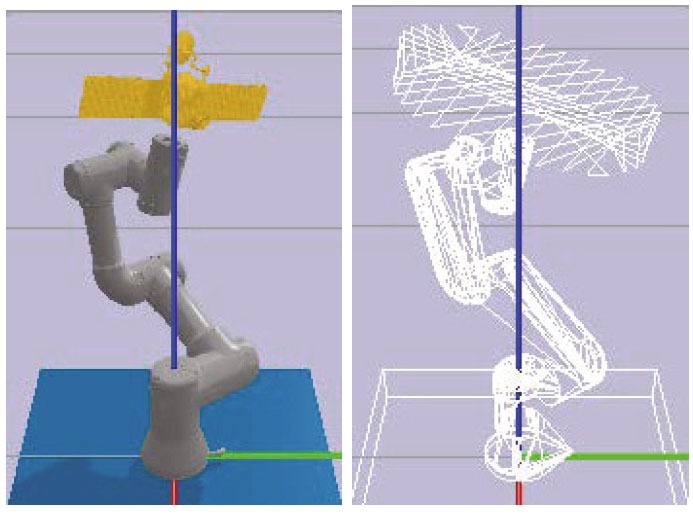
On-orbit service is important for maintaining the sustainability of the space environment. A space-based visible camera is an economical and lightweight sensor for situational awareness during on-orbit service. However, it can be easily affected by the low illumination environment. Recently, deep learning has achieved remarkable success in image enhancement of natural images, but it is seldom applied in space due to the data bottleneck. In this study, we first propose a dataset of BeiDou navigation satellites for on-orbit low-light image enhancement (LLIE). In the automatic data collection scheme, we focus on reducing the domain gap and improving the diversity of the dataset. We collect hardware-in-the-loop images based on a robotic simulation testbed imitating space lighting conditions. To evenly sample poses of different orientations and distances without collision, we propose a collision-free workspace and pose-stratified sampling. Subsequently, we develop a novel diffusion model. To enhance the image contrast without over-exposure and blurred details, we design fused attention guidance to highlight the structure and the dark region. Finally, a comparison of our method with previous methods indicates that our method has better on-orbit LLIE performance.
1. Introduction
Due to the high frequency (HF) of space activities, the space environment has been seriously degraded as a by-product of these activities. As of February 2022, more than 25,000 space objects have been identified, including retired satellites, spacecraft, rocket bodies, and debris (Cowardin and Miller, 2022), which gravely threaten both the existing and newly launched spacecraft (Ledkov and Aslanov, 2022). Hence, to ensure the long-term sustainability of the space environment, clean up existing space debris, and extend the lifespan of operational spacecraft, active debris removal (ADR) and on-orbit servicing (OOS) have emerged as popular research areas (Poozhiyil et al., 2023). The space robotic arm plays a vital role in performing various tasks associated with ADR and OOS, including capturing, docking, repairing, and refurbishing, as demonstrated in Fig. 1a. To realize safe and efficient robotic control, reliable sensors and data analysis are required to provide better space situational awareness (SSA), especially when manipulating unknown targets (Harris et al., 2021; Civardi et al., 2024). A space-based visible camera is one of the most essential sensors because of its advantages: it is lightweight in mass, compact in size, economical in power, and informative in data (Diao et al., 2011). However, the variable illumination in space can seriously affect the quality of the captured images, especially when the satellite is in the Earth's shadow, as shown in Figs. 1b and 1c. The captured images can be extremely invisible, making it difficult to extract key features. To recover the buried details and improve data usability for downstream tasks and the surveillance efficiency of SSA, we propose a novel framework to solve the problem of on-orbit low-light image enhancement (LLIE).
Image enhancement methods based on classical theory (Rahman et al., 1996; Guo et al., 2017; Ying et al., 2017; Li MD et al., 2018; Ren et al., 2018) have been widely used to improve image contrast. Unfortunately, these methods are suitable only for situations in which images already contain a good representation of the scene content. For extremely dark and noisy images, they are likely to cause severe noise amplification after enhancement. Deep learning (DL) methods have been applied to solve problems in various industries, demonstrating significant advancements (Li CY et al., 2022; Xu et al., 2023, 2024). DL-based methods for LLIE can be classified as one-way neural networks (Wei et al., 2018; Li N and Zhang, 2019; Xu et al., 2021; Dang et al., 2023; Huang et al., 2023; Shi et al., 2024; Yan et al., 2024) and generative adversarial networks.
Loading authentic research manuscript (Pages 1–5)...
Yiman ZHU, Lu WANG, Jingyi YUAN, Yu GUO (2025). A ground-based dataset and diffusion model for on-orbit low-light image enhancement. Frontiers of Information Technology & Electronic Engineering. https://doi.org/10.1631/FITEE_2400261
Research & Educational Purpose Only:The translations, structured abstracts, analytical annotations, and data reports provided by SinoTechIntel are intended exclusively for academic research, internal corporate R&D, and educational benchmarking. They do not constitute formal engineering, chemical safety, legal, or professional advice.
Copyright & Intellectual Property Notice: Original copyright of the underlying source articles and experimental data remains with the respective authors, institutions, and original publishing journals. SinoTechIntel claims intellectual property only over its proprietary translations, analytical syntheses, and AEO structured enhancements in accordance with international fair use and academic citation principles.
Frequently Asked Questions
What is on-orbit low-light image enhancement (LLIE)?
It is a computer vision task aimed at recovering hidden structures and improving the usability of images captured by space-based visible cameras in low illumination, such as when satellites are in Earth's shadow.
Why is deep learning seldom applied to on-orbit image enhancement?
Due to the data bottleneck—there is a lack of large-scale, realistic datasets of low-light space images. Existing datasets are mostly natural images, creating a domain gap that limits model performance.
What dataset is proposed in this study?
A ground-based dataset of BeiDou navigation satellites for on-orbit LLIE, collected using a robotic simulation testbed with hardware-in-the-loop and imitating space lighting conditions.
How does the proposed diffusion model work?
It uses fused attention guidance to simultaneously enhance image contrast and highlight structures and dark regions, preventing over-exposure and blurred details.
What are the main contributions of this paper?
The dataset collection scheme reduces domain gap and improves diversity; the diffusion model achieves better on-orbit LLIE performance than previous methods.
Related Technical Papers & Translations

Design and optimization of a high-efficiency distillation process for cellulosic fuel ethanol integrated with thermal coupling and molecular sieve adsorption
To address the challenges of high energy consumption and prominent costs in the traditional three-columns distillation process for cellulosic fuel ethanol, a distillation—molecular sieve coupling separation process is proposed. This process integrates a three-column (crude distillation column, first distillation column, second distillation column) system with a 3A molecular sieve adsorption deep dehydration unit. A thermal coupling network is constructed via differential pressure design (steam from medium/high-pressure columns as mutual heat sources, reboiler liquid waste heat for feed preheating), and molecular sieve adsorption conditions are optimized. The study first performs a thermodynamic consistency test on the ethanol—water system, determines optimal non-random two-liquid (NRTL) model binary interaction parameters via experimental data regression for Aspen Plus simulation. Aiming at minimum total annual cost (TAC), Aspen Plus is used to optimize process parameters (theoretical tray number, feed location, reflux ratio, side-draw position, etc.). Economic analysis shows this process reduces CO2 emission costs by 27.56%, TAC by 15.58% (to 5.123 × 10⁶ USD·a-1), and increases ethanol purity to >99.6%, providing an effective solution for green, efficient separation.

A cohesion loss model for determining residual strength of deep bedded sandstone
Rock residual strength, as an important input parameter, plays an indispensable role in proposing the reasonable and scientific scheme about stope design, underground tunnel excavation and stability evaluation of deep chambers. Therefore, previous residual strength models of rocks established were reviewed. And corresponding related problems were stated. Subsequently, starting from the effects of bedding and whole life-cycle evolution process, series of triaxial mechanical tests of deep bedded s

Federated model with contrastive learning and adaptive control variates for human activity recognition
Recent attention to privacy issues demands a communication-safe method for training human activity recognition (HAR) models on client activity data. Federated learning (FL) has become a compelling technique to facilitate model training between the server and clients while preserving data privacy. However, classical FL methods often assume independent and identically distributed (IID) data among clients. This assumption does not hold true in practical scenarios. Human activity in real-world scena