Key Takeaways & Executive Findings
- •• Proposes SAPC-DKNN, a dynamic K-nearest neighbor indoor positioning method that uses RSS path loss and RSS fluctuation area to quantify access point significance and credibility. • Introduces ND-DKA, an automatic neighbor-density-based K-value algorithm that optimizes the number of nearest neighbors for each test point, overcoming the limitations of a fixed K value. • Achieves 15.41%–64.74% reduction in average positioning error relative to state-of-the-art KNN methods across three indoor positioning datasets. • Demonstrates a robust fingerprint-based Wi-Fi positioning framework with strong AP credibility weighting, suitable for patient monitoring, equipment scheduling, and laboratory safety.
Abstract
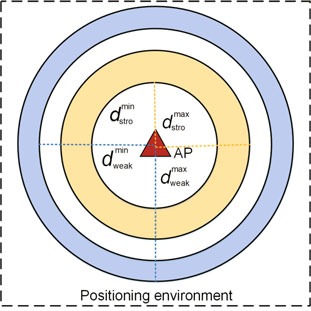
High-precision indoor positioning offers valuable information support for various services such as patient monitoring, equipment scheduling management, and laboratory safety. A traditional indoor positioning technology, fingerprint indoor positioning, often employs the K-nearest neighbor (KNN) algorithm to identify the closest K reference points (RPs) via the received signal strength (RSS) for location prediction. However, RSS is susceptible to environmental interference, leading to the selection of RPs that are not physically the closest to the user. Moreover, using a fixed K value is not the optimal strategy. In this work, we propose a novel approach, the dynamic K-nearest neighbor method based on strong access point (AP) credibility (SAPC-DKNN), for indoor positioning. In SAPC-DKNN, we leverage prior knowledge of RSS path loss and employ the RSS fluctuation area to quantify the significance of different APs. We integrate the similarity of AP sets within the range of strong APs and formulate a weighted distance metric for RSS based on the credibility of strong APs. Additionally, we introduce a dynamic K-value algorithm based on neighbor density (ND-DKA) for the automatic optimization of the K value for each test point. Experimental evaluations conducted on three datasets demonstrate that our method significantly reduces the average positioning error by 15.41%–64.74% compared to the state-of-the-art KNN methods.
1. Introduction
The rapid progress of wireless communication technology has led to increased attention concerning location-based services that rely on positioning technology (Liu H et al., 2007; Gu et al., 2009; Song et al., 2019). These services are ubiquitous in daily life. They are found in places like roads, playgrounds, underground parking lots, shopping malls, laboratories, and classrooms, and play a vital role in supporting travel navigation, scheduling equipment, ensuring laboratory and personnel safety, etc. Although the Global Navigation Satellite System (GNSS) excels in outdoor environments (Hegarty and Chatre, 2008), its signals are influenced by factors such as geomagnetism, weather, and building obstructions in indoor settings, which cause signal distortion and hinder the provision of accurate and reliable positioning information (Nguyen et al., 2024; Zhao et al., 2024).
In the current landscape, effective indoor positioning is attainable through technologies like Wi-Fi (Yang and Shao, 2015; Cha and Lim, 2022), Bluetooth (Liu S et al., 2014; Pu and You, 2018), ZigBee (Dong ZY et al., 2019), radio frequency identification (RFID) (Ni et al., 2003; Chon et al., 2004), and ultra-wideband (UWB) (Yu et al., 2021). Wi-Fi, in particular, stands out due to its low power consumption, high real-time performance, low deployment cost, and robust environmental adaptability, making it popular for wide application in indoor positioning and the Internet of Things (Ma J et al., 2008; Salamah et al., 2016; Dong YH et al., 2022).
Due to the widespread deployment of Wi-Fi infrastructure in indoor settings, indoor positioning methods based on Wi-Fi are commonly categorized into two types: ranging-based and fingerprint-based (Rusli et al., 2016; Nguyen et al., 2023). In ranging-based methods, the received signal strength (RSS) value is typically employed to compute the distance between the test point (TP) and the access point (AP) using the RSS propagation loss model (Ciurana et al., 2007; Dag and Arsan, 2018). However, these methods are susceptible to environmental variations and lead to increased estimation errors due to changing obstacles. In contrast, the fingerprint positioning algorithm does not determine the target location by estimating the distance between the TP and the AP. Instead, it estimates the location by assessing the RSS distance between the TP and the offline-collected database (Xia et al., 2015; Alitakeshi et al., 2023). During the offline phase, the fingerprint database is created and stores the received signal strength indicator (RSSI) and the corresponding coordinates of all APs collected at each reference point (RP) using mobile devices. In the online phase of position estimation, the mobile device gathers the user's current location information, and the RP information in the database is used to estimate the location of the target point with the highest probability. The appeal of the fingerprint-based algorithm lies in its capacity to enhance positioning accuracy without incurring additional hardware costs, making it a subject of interest for many scholars.
Loading authentic research manuscript (Pages 1–5)...
Yuting Yang, Tao Zhang, Wu Huang (2025). A dynamic K-nearest neighbor method based on strong access point credibility for indoor positioning. Frontiers of Information Technology & Electronic Engineering. https://doi.org/10.1631/FITEE_2400366
Research & Educational Purpose Only:The translations, structured abstracts, analytical annotations, and data reports provided by SinoTechIntel are intended exclusively for academic research, internal corporate R&D, and educational benchmarking. They do not constitute formal engineering, chemical safety, legal, or professional advice.
Copyright & Intellectual Property Notice: Original copyright of the underlying source articles and experimental data remains with the respective authors, institutions, and original publishing journals. SinoTechIntel claims intellectual property only over its proprietary translations, analytical syntheses, and AEO structured enhancements in accordance with international fair use and academic citation principles.
Frequently Asked Questions
What is SAPC-DKNN?
SAPC-DKNN (Strong Access Point Credibility-based Dynamic K-Nearest Neighbor) is a novel indoor positioning method that improves traditional KNN fingerprinting by leveraging RSS path loss knowledge and RSS fluctuation areas to quantify the significance of different access points. It integrates AP set similarity within strong AP ranges and uses a weighted RSS distance metric based on strong AP credibility to select reference points.
How does SAPC-DKNN select the optimal K value?
SAPC-DKNN introduces a dynamic K-value algorithm based on neighbor density (ND-DKA). This algorithm automatically optimizes the number of nearest neighbors (K) for each test point based on the density of neighboring reference points, avoiding the limitations of a fixed K value and improving localization accuracy.
What improvement in positioning error does SAPC-DKNN achieve?
Experimental evaluations on three indoor positioning datasets show that SAPC-DKNN reduces the average positioning error by 15.41% to 64.74% compared with state-of-the-art K-nearest neighbor methods.
Why is strong access point credibility important in indoor positioning?
RSS signals are highly susceptible to environmental interference, causing some access points to provide unreliable distance information. By quantifying the credibility of strong APs using RSS path loss and fluctuation area, SAPC-DKNN assigns appropriate weights to RSS distances, preventing physically distant reference points from being mistakenly selected as nearest neighbors.
What are the practical applications of the proposed method?
The proposed method is designed for high-precision indoor positioning scenarios such as patient monitoring, equipment scheduling management, laboratory safety, and other location-based services in environments where GNSS signals are unreliable.
Related Technical Papers & Translations

Design and optimization of a high-efficiency distillation process for cellulosic fuel ethanol integrated with thermal coupling and molecular sieve adsorption
To address the challenges of high energy consumption and prominent costs in the traditional three-columns distillation process for cellulosic fuel ethanol, a distillation—molecular sieve coupling separation process is proposed. This process integrates a three-column (crude distillation column, first distillation column, second distillation column) system with a 3A molecular sieve adsorption deep dehydration unit. A thermal coupling network is constructed via differential pressure design (steam from medium/high-pressure columns as mutual heat sources, reboiler liquid waste heat for feed preheating), and molecular sieve adsorption conditions are optimized. The study first performs a thermodynamic consistency test on the ethanol—water system, determines optimal non-random two-liquid (NRTL) model binary interaction parameters via experimental data regression for Aspen Plus simulation. Aiming at minimum total annual cost (TAC), Aspen Plus is used to optimize process parameters (theoretical tray number, feed location, reflux ratio, side-draw position, etc.). Economic analysis shows this process reduces CO2 emission costs by 27.56%, TAC by 15.58% (to 5.123 × 10⁶ USD·a-1), and increases ethanol purity to >99.6%, providing an effective solution for green, efficient separation.

A cohesion loss model for determining residual strength of deep bedded sandstone
Rock residual strength, as an important input parameter, plays an indispensable role in proposing the reasonable and scientific scheme about stope design, underground tunnel excavation and stability evaluation of deep chambers. Therefore, previous residual strength models of rocks established were reviewed. And corresponding related problems were stated. Subsequently, starting from the effects of bedding and whole life-cycle evolution process, series of triaxial mechanical tests of deep bedded s

Federated model with contrastive learning and adaptive control variates for human activity recognition
Recent attention to privacy issues demands a communication-safe method for training human activity recognition (HAR) models on client activity data. Federated learning (FL) has become a compelling technique to facilitate model training between the server and clients while preserving data privacy. However, classical FL methods often assume independent and identically distributed (IID) data among clients. This assumption does not hold true in practical scenarios. Human activity in real-world scena