Key Takeaways & Executive Findings
- •• A human-interactive digital simulation platform for work-class ROVs integrates navigation, motion, and teleoperated manipulation with immersive visual and force feedback. • Two distinct mechanisms provide operator training and real-time telepresence, along with an open data interface for algorithm pretesting. • Case studies on sediment sampling and pipeline docking validate the platform with DWA-based navigation, SMC control, and teleoperation frameworks. • A user study demonstrates the platform's superiority and accuracy in immersive underwater teleoperation, supporting safe and cost-effective ROV operations.
Abstract
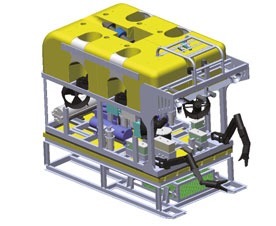
Digital simulation of the full operation of a remotely operated vehicle (ROV) is an economically feasible way for algorithm pretesting and operator training prior to the actual underwater tasks, due to the huge difficulties encountered during the underwater test, high equipment cost, and the time-consuming nature of the process. In this paper, a human-interactive digital simulation platform is established for the navigation, motion, and teleoperated manipulation of work-class ROVs, and provides the human operator with the visualized full operation process. Specially, two mechanisms are presented in this platform: one provides the virtual simulation platform for operator training; the other provides real-time visual and force feedback when implementing the actual tasks. Moreover, an open data interface is designed for researchers for pretesting various algorithms before implementing the actual underwater tasks. Additionally, typical underwater scenarios of the ROV, including underwater sediment sampling and pipeline docking tasks, are selected as the case studies for hydrodynamics-based simulation. Human operator can operate the manipulator installed on the ROV via the master manipulator with the visual and force feedback after the ROV is navigated to the desired position. During the full operation, the dynamic windows approach (DWA)-based local navigation algorithm, sliding mode control (SMC) controller, and the teleoperation control framework are implemented to show the effectiveness of the designed platform. Finally, a user study on the ROV operation mode is carried out, and several metrics are designed to evaluate the superiority and accuracy of the digital simulation platform for immersive underwater teleoperation.
1. Introduction
With the development of robotics (Hokayem and Spong, 2006; Liu et al., 2017; Chen et al., 2023), remotely operated vehicles (ROVs) have attracted increasing attention, whereby work-class ROVs can effectively replace human operators during the execution of remote and complex underwater tasks from a safe place onboard (Forbrigger and Pan, 2018; Wang et al., 2020; Lu et al., 2022). Therefore, work-class ROVs are widely used in offshore and deep-sea operations, such as sampling and pipeline docking. The full operation process of a work-class ROV starts with navigation to the designated position (Long et al., 2022). Once the ROV reaches the designated operation area, it transitions from the navigation mode to the operation mode. At this stage, the human operator takes over, and teleoperates the manipulator installed on the ROV to perform precise tasks (Zhang JJ et al., 2018). To adapt to various operational environments and to improve the safety and precision of underwater tasks, tailored ROV navigation, motion control algorithms, and teleoperation control algorithms need to be developed for work-class ROVs. However, there still remain challenges in algorithm development for work-class ROVs, mainly due to the difficulties encountered during the underwater test, high equipment cost, and the time-consuming nature of the process. To address these issues, the establishment of a digital simulation platform becomes a feasible solution for algorithm pretesting and operator training for the full operation process before undertaking the actual tasks (Li et al., 2022).
Due to the complex terrain and the limited light in underwater environments, autonomous navigation and motion control of ROVs can effectively assist human operators in controlling the ROV to reach the desired positions (Kinsey et al., 2014; Zhao et al., 2014; Manzanilla et al., 2019; Tani et al., 2023). The typical method to test the navigation and motion control algorithm is to apply offline simulators, which have high calculation efficiency (Huang et al., 2023). However, it is difficult to support inter
Loading authentic research manuscript (Pages 1–5)...
Fanghao Huang, Xiao Yang, Xuanlin Chen, Deqing Mei, Zheng Chen (2025). A digital simulation platform with human-interactive immersive design for navigation, motion, and teleoperated manipulation of work-class remotely operated vehicle. Frontiers of Information Technology & Electronic Engineering. https://doi.org/10.1631/FITEE_2400486
Research & Educational Purpose Only:The translations, structured abstracts, analytical annotations, and data reports provided by SinoTechIntel are intended exclusively for academic research, internal corporate R&D, and educational benchmarking. They do not constitute formal engineering, chemical safety, legal, or professional advice.
Copyright & Intellectual Property Notice: Original copyright of the underlying source articles and experimental data remains with the respective authors, institutions, and original publishing journals. SinoTechIntel claims intellectual property only over its proprietary translations, analytical syntheses, and AEO structured enhancements in accordance with international fair use and academic citation principles.
Frequently Asked Questions
What is the main purpose of the digital simulation platform for work-class ROVs?
The platform provides a human-interactive immersive design for simulating navigation, motion, and teleoperated manipulation of work-class ROVs. It enables algorithm pretesting and operator training before actual underwater tasks, significantly reducing cost and time.
How does the platform provide visual and force feedback during teleoperation?
The platform incorporates two mechanisms: one for virtual simulation-based operator training and another for real-time visual and force feedback during actual task execution. This telepresence capability allows operators to manipulate the ROV through a master manipulator with immersive feedback.
Which case studies are used to demonstrate the platform's capabilities?
Typical underwater scenarios, including sediment sampling and pipeline docking, are selected as case studies. These tasks involve hydrodynamics-based simulation, and the platform successfully integrates DWA-based navigation, sliding mode control (SMC), and teleoperation control frameworks.
What metrics are used to evaluate the platform's performance?
A user study on ROV operation mode is carried out, with several metrics designed to assess the superiority and accuracy of the digital simulation platform for immersive underwater teleoperation.
Can researchers use this platform for algorithm pretesting?
Yes, the platform includes an open data interface specifically designed for researchers to pretest various algorithms before implementing them in actual underwater tasks.
Related Technical Papers & Translations

Design and optimization of a high-efficiency distillation process for cellulosic fuel ethanol integrated with thermal coupling and molecular sieve adsorption
To address the challenges of high energy consumption and prominent costs in the traditional three-columns distillation process for cellulosic fuel ethanol, a distillation—molecular sieve coupling separation process is proposed. This process integrates a three-column (crude distillation column, first distillation column, second distillation column) system with a 3A molecular sieve adsorption deep dehydration unit. A thermal coupling network is constructed via differential pressure design (steam from medium/high-pressure columns as mutual heat sources, reboiler liquid waste heat for feed preheating), and molecular sieve adsorption conditions are optimized. The study first performs a thermodynamic consistency test on the ethanol—water system, determines optimal non-random two-liquid (NRTL) model binary interaction parameters via experimental data regression for Aspen Plus simulation. Aiming at minimum total annual cost (TAC), Aspen Plus is used to optimize process parameters (theoretical tray number, feed location, reflux ratio, side-draw position, etc.). Economic analysis shows this process reduces CO2 emission costs by 27.56%, TAC by 15.58% (to 5.123 × 10⁶ USD·a-1), and increases ethanol purity to >99.6%, providing an effective solution for green, efficient separation.

A cohesion loss model for determining residual strength of deep bedded sandstone
Rock residual strength, as an important input parameter, plays an indispensable role in proposing the reasonable and scientific scheme about stope design, underground tunnel excavation and stability evaluation of deep chambers. Therefore, previous residual strength models of rocks established were reviewed. And corresponding related problems were stated. Subsequently, starting from the effects of bedding and whole life-cycle evolution process, series of triaxial mechanical tests of deep bedded s

Federated model with contrastive learning and adaptive control variates for human activity recognition
Recent attention to privacy issues demands a communication-safe method for training human activity recognition (HAR) models on client activity data. Federated learning (FL) has become a compelling technique to facilitate model training between the server and clients while preserving data privacy. However, classical FL methods often assume independent and identically distributed (IID) data among clients. This assumption does not hold true in practical scenarios. Human activity in real-world scena