Key Takeaways & Executive Findings
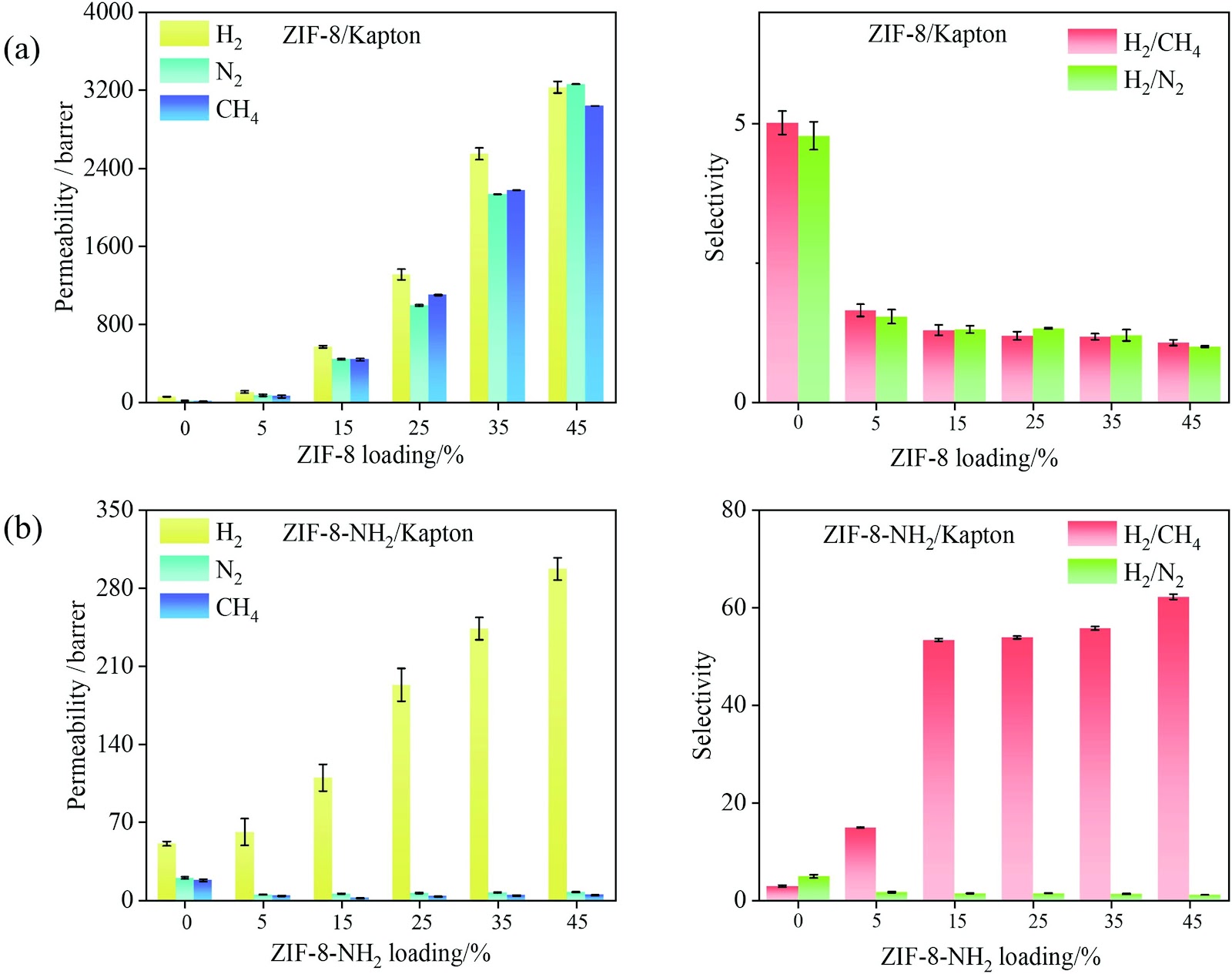
- •• Covalent integration of ZIF-8-NH2 with Kapton polyamide acid eliminates filler aggregation, enabling high filler loading (45% mass) without compromising membrane integrity. • The optimized MMM achieves H2 permeability of 297 barrer and H2/N2 and H2/CH4 selectivities of 43.9 and 62.2, respectively, surpassing the Robeson 2008 upper bound. • The covalent bridging between filler and polymer matrix creates a defect-free interface, significantly improving gas separation performance. • This work provides a novel strategy for fabricating high-performance MMMs for hydrogen purification and other gas separation applications.
Abstract
Zeolitic imidazolate framework-8 (ZIF-8) is a typical filler used to fabricate mixed matrix membranes (MMMs) on account of its attractive advantage of high selective permeability for gas separation. However, the performance is usually affected by filler aggregation due to strong interactions among fillers and weak interactions between the polymer and fillers, which will lead to a decrease of selectivity and the performance of gas separation will be strongly influenced. Herein, we modified ZIF-8 with 3-amino-1,2,4-triazole to obtain ZIF-8-NH2, Kapton polyamide acid was selected as the polymer matrix. Results showed that the ZIF-8-NH2/Kapton MMMs has a good compatibility interface between ZIF-8 and Kapton because of the covalent bridging, even the filler loading up to 45% (mass). The 45% (mass) of ZIF-8-NH2/Kapton membrane showed 297 barrer (1 barrer = 10^-10 cm3·cm·cm^-2·s^-1·cmHg^-1, 1 cmHg = 1333.22 Pa, standard temperature and pressure) of the permeability of H2 and 43.9 and 62.2 of selectivities for H2/N2 and for H2/CH4, respectively, which are beyond the upper limit of Robeson 2008.
1. Introduction
At present, the global warming due to the excessive emission of CO2 is becoming more and more serious. Searching for a clean energy source is highly attractive for addressing the growing environmental problems [1]. H2, a green energy source, has a higher energy density than conventional fuels, and typically requires a further purification through a series of separation technologies to meet usage towards high purity [2]. In comparison to the conventional adsorption and distillation, membrane technology offers distinct advantages e.g. low energy consumption, simple operation, easy scalability, and a smaller footprint [3].
Membrane material dominates the whole process economy for gas purification, and especially, polymeric membranes are widely used due to a great processability and low price [4]. The organic microporous materials play an important role in mass transfer due to their unique properties, such as the gas permeability and Brunauer-Emmett-Teller (BET) surface area [5]. Li et al. [6] fabricated a polydimethylsiloxane healed BTDA-TDI/MDI (P84) membranes with selectivities for H2/CH4 and H2/N2 3.4 and 3.7 times of P84 without being healed, respectively. Li et al. [7] synthesized the hyper cross-linked polyimide modified with -NH2 to improve CO2 separation, which reached a permeability of 77.56 barrer (1 barrer = 10^-10 cm3·cm·cm^-2·s^-1·cmHg^-1, 1 cmHg = 1333.22 Pa, standard temperature and pressure (STP)) for CO2. Generally, more complex multistep operations are necessary for a lower selectivity, while the membrane productivity is correlated with the permeability, and thus the required number of modules and the membrane area are determined [4,8]. Unfortunately, a “trade-off” effect limits the separation performance of polymeric membranes, namely membrane with a high permeability usually results in a low selectivity and vice versa [9-11]. This theory was described as Robeson upper bound plot for gas separation described in polymeric membranes [12].
Mixed matrix membranes (MMMs) are developed by doping specific nano/micron-sized particles in the polymeric matrix, where the conspicuous processability of polymer and the permeability of fillers are combined. Metal-organic frameworks (MOFs) membranes generally exhibit higher gas permeability and selectivity than the conventional polymeric membranes, owing to their uniform channel structure, appropriate pore size for the transfer of gases. For instance, Jheng et al. [13] blended zirconium 1,4-dicarboxybenzene MOF into immiscible 4,4’-(hexafluoroisopropylidene) diphthalic anhydride (6FDA) polyimide and when the loading reached 35% (mass) of the filler, the permeability towards CO2 attained 104.7 barrer and the selectivities of CO2/CH4 and CO2/N2 are 31.7 ± 5.8, 16.5 ± 1.5 respectively. Ehsani and Pakizeh [14] used the MOF micron particles of zeolitic imidazolate framework-11 as the filler and Pebax as the polymer matrix to fabric MMM, they found the performance of gas separation of H2
Loading authentic research manuscript (Pages 1–5)...
Guozhen Li, Shiqi Ling, Yuhui Cui, Shilong Dong, Tianyin Liu, Ting Li, Siyu Pang, Peiyong Qin (2024). A covalently integrated ZIF-8/polyamide acid mixed matrix membrane with superior gas separation performance. Chinese Journal of Chemical Engineering. https://doi.org/10.1016/j_cjche_144878629
Research & Educational Purpose Only:The translations, structured abstracts, analytical annotations, and data reports provided by SinoTechIntel are intended exclusively for academic research, internal corporate R&D, and educational benchmarking. They do not constitute formal engineering, chemical safety, legal, or professional advice.
Copyright & Intellectual Property Notice: Original copyright of the underlying source articles and experimental data remains with the respective authors, institutions, and original publishing journals. SinoTechIntel claims intellectual property only over its proprietary translations, analytical syntheses, and AEO structured enhancements in accordance with international fair use and academic citation principles.
Frequently Asked Questions
What is the main innovation of this paper?
The main innovation is the covalent integration of ZIF-8-NH2 with Kapton polyamide acid, which eliminates filler aggregation and creates a defect-free interface, enabling high filler loading (45% mass) and superior gas separation performance.
What gas separation performance was achieved?
The optimized membrane achieved H2 permeability of 297 barrer and H2/N2 and H2/CH4 selectivities of 43.9 and 62.2, respectively, surpassing the Robeson 2008 upper bound.
Why is ZIF-8 modified with 3-amino-1,2,4-triazole?
Modification introduces amino groups that covalently bond with the polyamide acid matrix, improving interfacial compatibility and preventing filler aggregation.
What is the significance of surpassing the Robeson upper bound?
Surpassing the Robeson upper bound indicates that the membrane achieves a better trade-off between permeability and selectivity than most polymeric membranes, making it promising for industrial gas separation applications.
What are the potential applications of this membrane?
The membrane is particularly suitable for hydrogen purification from gas mixtures (e.g., H2/N2 and H2/CH4), which is relevant to clean energy production and petrochemical processes.
Related Technical Papers & Translations

Design and optimization of a high-efficiency distillation process for cellulosic fuel ethanol integrated with thermal coupling and molecular sieve adsorption
To address the challenges of high energy consumption and prominent costs in the traditional three-columns distillation process for cellulosic fuel ethanol, a distillation—molecular sieve coupling separation process is proposed. This process integrates a three-column (crude distillation column, first distillation column, second distillation column) system with a 3A molecular sieve adsorption deep dehydration unit. A thermal coupling network is constructed via differential pressure design (steam from medium/high-pressure columns as mutual heat sources, reboiler liquid waste heat for feed preheating), and molecular sieve adsorption conditions are optimized. The study first performs a thermodynamic consistency test on the ethanol—water system, determines optimal non-random two-liquid (NRTL) model binary interaction parameters via experimental data regression for Aspen Plus simulation. Aiming at minimum total annual cost (TAC), Aspen Plus is used to optimize process parameters (theoretical tray number, feed location, reflux ratio, side-draw position, etc.). Economic analysis shows this process reduces CO2 emission costs by 27.56%, TAC by 15.58% (to 5.123 × 10⁶ USD·a-1), and increases ethanol purity to >99.6%, providing an effective solution for green, efficient separation.

A cohesion loss model for determining residual strength of deep bedded sandstone
Rock residual strength, as an important input parameter, plays an indispensable role in proposing the reasonable and scientific scheme about stope design, underground tunnel excavation and stability evaluation of deep chambers. Therefore, previous residual strength models of rocks established were reviewed. And corresponding related problems were stated. Subsequently, starting from the effects of bedding and whole life-cycle evolution process, series of triaxial mechanical tests of deep bedded s

Federated model with contrastive learning and adaptive control variates for human activity recognition
Recent attention to privacy issues demands a communication-safe method for training human activity recognition (HAR) models on client activity data. Federated learning (FL) has become a compelling technique to facilitate model training between the server and clients while preserving data privacy. However, classical FL methods often assume independent and identically distributed (IID) data among clients. This assumption does not hold true in practical scenarios. Human activity in real-world scena