Novel CO2 Adsorbent Prepared with ZSM-5/MCM-48 as Support: High Adsorption Property and Its Mechanism
Authors: WEI Jianwen, ZHANG Lijuan, GENG Linlin, LI Yu, LIAO Lei, WANG Dunqiu
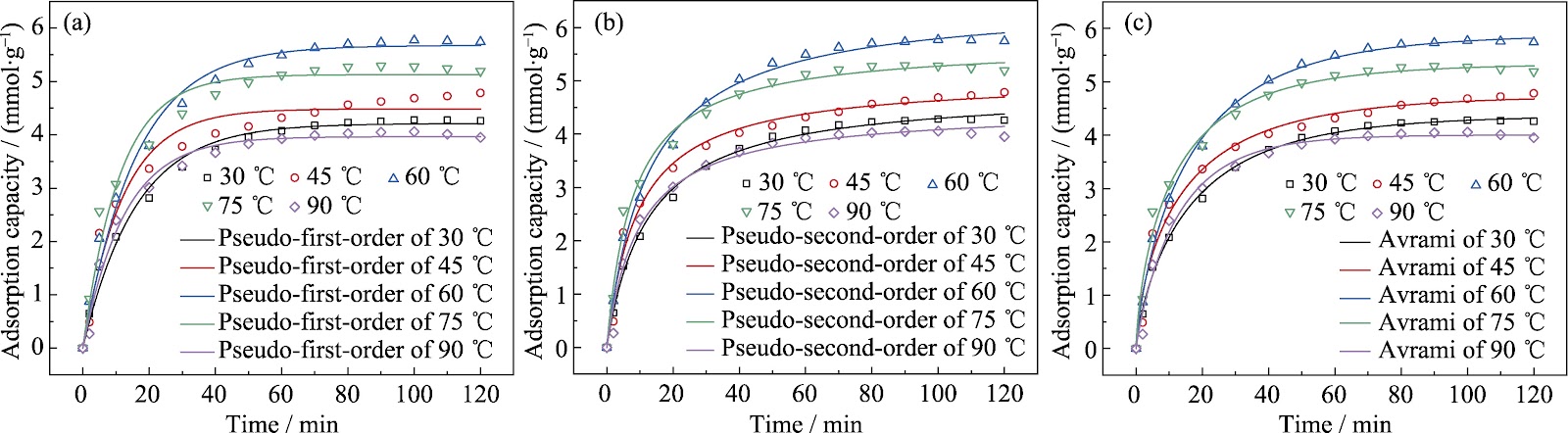
Adsorption by solid amine adsorbent is a promising technology for decarbonization of flue gas. However, adsorption properties of many solid amine adsorbents need to be enhanced, and it is necessary to further study the CO2 adsorption mechanism. A novel CO2 adsorbent with high capacity was obtained by grafting 3-aminopropyltriethoxysilane (APTES) on a micro-mesoporous composite molecular sieve ZSM-5/MCM-48 as the support, and then impregnated with tetraethylenepentamine (TEPA) or polyethyleneimine (PEI). The maximum adsorption capacity of APTES-ZSM-5/MCM-48-TEPA-60 (A-ZM-T60), loaded with 60% (in mass) TEPA, for CO2 reaches 5.82 mmol·g–1 at 60 ℃ in 15% (in volume) CO2. Carbamate, alkyl ammonium carbamate and carbonate are generated during the chemical adsorption, which is dominant for CO2 adsorption because of the reaction between CO2 and amino groups on the adsorbent, simultaneously accompanied by weak physical adsorption. All above data confirm that these composites display an outstanding adsorption performance with a bright future for CO2 capture from flue gas after desulfurization.