Mechanisms of enhanced wettability and nanomechanical strength in soft coal seams modified by acidic SiO2 nanofluids
Authors: Linfan Qi, Xianfeng Liu, Baisheng Nie, Jialiang Li, Peng Chen, Han Han, Zhongbei Li, Shanyang Wei, Bozhi Deng
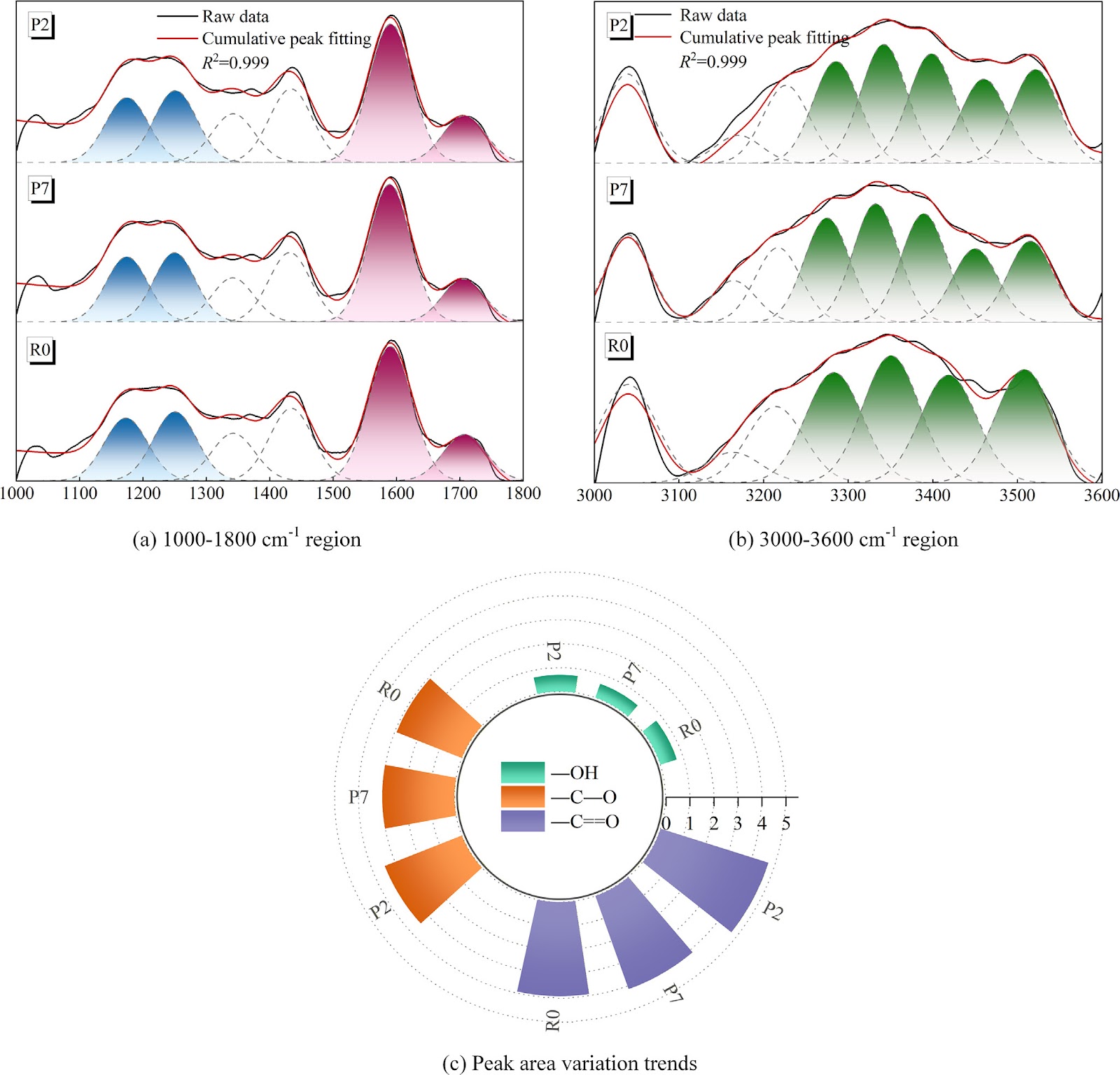
Conventional hydraulic fracturing is widely used for underground gas control in coal mines; however, in deep, soft coal seams, poor wettability and low mechanical strength can cause rapid energy release under gas pressure and mining-induced disturbances. These conditions increase the risk of coal and gas outbursts, complicate rapid outburst elimination, and pose serious threats to safe mine operations. In this study, SiO2 nanofluid solutions with varying acidity were prepared, and molecular dynamics simulations, contact angle measurements, Fourier transform infrared spectroscopy, nanoindentation tests, and three-dimensional super-depth microscopy were employed to systematically investigate the mechanisms by which acidic SiO2 nanofluids enhance the wettability and nanomechanical strength of soft coal seams. The results show that SiO2 nanoparticles act as bridging agents between water molecules and the coal matrix. In the high-mass fraction H2O/SiO2/coal system, the adsorption layer thickness increases from 15.44 Å in the pure water system to 20.51 Å. Acidic SiO2 nanofluids substantially reduce the coal-water contact angle; at pH 2, the contact angle decreases to 47.9°, representing a 43.86% reduction relative to raw coal. The total absorption peak area of oxygen-containing functional groups increased accordingly, promoting a transition of the coal surface from hydrophobic to hydrophilic. SiO2 nanofluids with varying acidity also induce pronounced changes in the mechanical properties of coal samples. Under mildly acidic conditions (pH 5), the elastic modulus and hardness increase by 17.880% and 18.794%, respectively, while the peak displacement and contact displacement decrease by 8.056% and 8.117%. Mild acidity promotes the formation of local micropores and facilitates the embedding of SiO2 nanoparticles, enhancing structural support and improving nanomechanical performance. In contrast, under strong acidic conditions, the corrosion effect outweighs the supporting role of the nanoparticles, resulting in mechanical degradation. Overall, the synergistic effects of acidic environments and SiO2 nanofluids significantly influence the wettability and mechanical behavior of coal. By elucidating their combined modification mechanisms, this study provides theoretical support and new perspectives for fluid-injection enhancement and dynamic disaster prevention in deep, soft coal seams.