Prioritized Na+ Adsorption-Driven Cationic Electrostatic Repulsion Enables Highly Reversible Zinc Anodes at Low Temperatures
Authors: Guanchong Mao, Pan Xu, Xin Liu, Xingyu Zhao, Zexiang Shen, Dongliang Chao, Minghua Chen
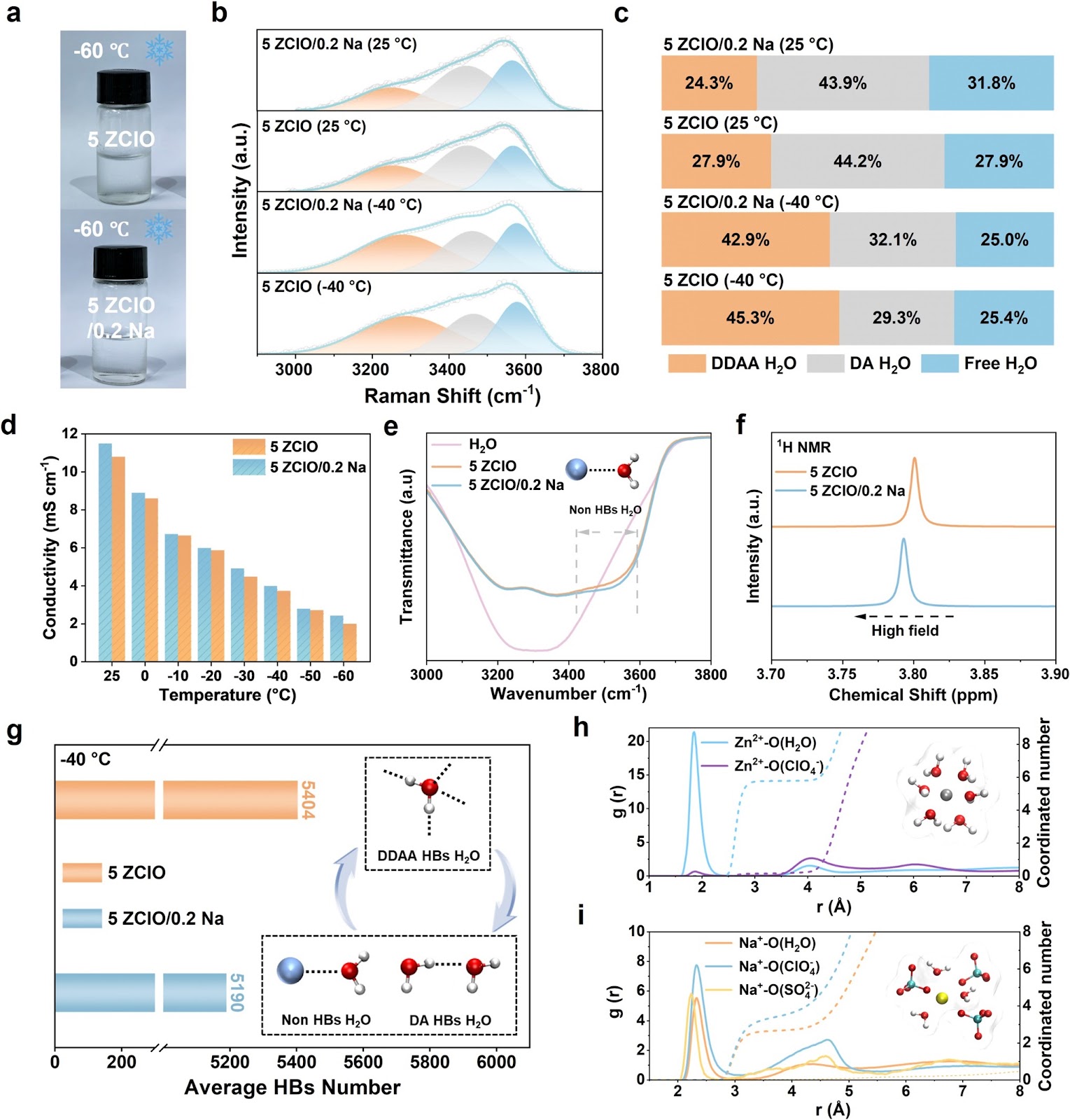
Aqueous zinc metal batteries (AZMBs) are promising candidates for renewable energy storage, yet their practical deployment in subzero environments remains challenging due to electrolyte freezing and dendritic growth. Although organic additives can enhance the antifreeze properties of electrolytes, their weak polarity diminishes ionic conductivity, and their flammability poses safety concerns, undermining the inherent advantages of aqueous systems. Herein, we present a cost-effective and highly stable Na2SO4 additive introduced into a Zn(ClO4)2-based electrolyte to create an organic-free antifreeze electrolyte. Through Raman spectroscopy, in situ optical microscopy, density functional theory computations, and molecular dynamics simulations, we demonstrate that Na+ ions improve low-temperature electrolyte performance and mitigate dendrite formation by regulating uniform Zn2+ deposition through preferential adsorption and electrostatic interactions. As a result, the Zn||Zn cells using this electrolyte achieve a remarkable cycling life of 360 h at −40 °C with 61% depth of discharge, and the Zn||PANI cells retained an ultrahigh capacity retention of 91% even after 8000 charge/discharge cycles at −40 °C. This work proposes a cost-effective and practical approach for enhancing the long-term operational stability of AZMBs in low-temperature environments.